

By Abbas Nazil
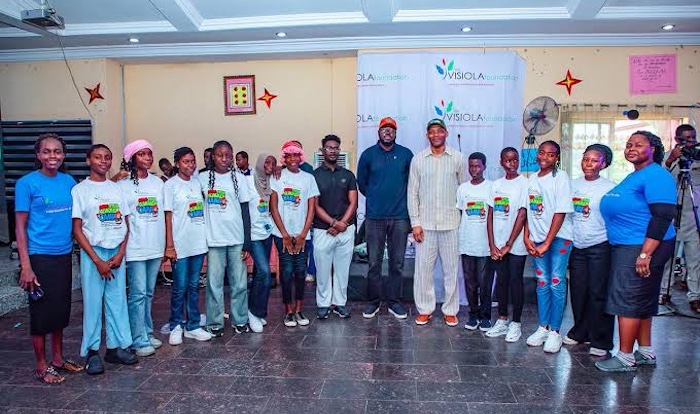
The Visiola Foundation has trained 100 girls from government secondary schools across Abuja in renewable energy, engineering, electronics and automation, as part of efforts to prepare young women for careers in Africa’s growing clean energy sector.
The eight-day 2026 Science, Technology, Engineering and Mathematics (STEM) Summer Camp, which ended on August 15, brought together girls aged 13 to 17 from 45 junior and senior government secondary schools across the Federal Capital Territory.
Held under the theme, “Powering the Future: Girls Leading Africa’s Renewable Energy Revolution,” the programme provided participants with practical knowledge and hands-on experience in solar and wind energy, electricity, smart technologies, microcontrollers and engineering design.
The participants were challenged to identify real energy-related problems in their communities and develop practical solutions through teamwork and project-based learning.
At the conclusion of the programme, the students presented functional renewable energy prototypes during a Renewable Energy Innovation Challenge, where their projects were assessed by a panel of experienced judges.
Group Eight emerged as the overall winner after developing a SmartFarm prototype featuring an automated farming system designed to make agricultural operations easier, safer and more efficient.
The President of the Visiola Foundation, Ladé Araba, said experiential STEM education was particularly important for students in public schools, where access to modern technical resources and learning opportunities could be limited.
Araba noted that Africa’s rapidly growing youth population coincided with increasing demand for digital and technical skills in the global labour market.
She said expanding practical STEM education in African public schools could help transform the continent’s growing youth population into a skilled workforce capable of contributing to economic growth, higher household incomes and technological development.
Chief Executive Officer of FGN Power Company, Kenny Anuwe, who served as chief judge of the closing competition, praised the participants for demonstrating strong technical understanding and creativity.
Anuwe said the students’ ability to understand engineering concepts, develop working prototypes and confidently explain their solutions demonstrated the potential of Africa’s young population to contribute to solving the continent’s energy challenges.
He stressed that investing in the next generation of engineers and innovators was essential because Africa’s energy challenges required the participation of all available talent, including young women.
According to him, initiatives that encourage girls to pursue careers in engineering and renewable energy would help strengthen Nigeria’s future technical workforce and contribute to building a more resilient and inclusive power sector.
During the camp, participants received training in solar and wind technologies, energy efficiency and conservation, energy storage, battery management, sensors, smart systems and microcontroller programming.
They also learned how to take an engineering idea from the initial concept stage through design, construction, testing and development into a functional prototype.
The training was delivered through a combination of technical instruction from engineering professionals and practical exercises designed to help the students apply classroom knowledge to real-world energy challenges.
Other projects showcased at the closing challenge included solar-powered devices, automated lighting systems, electronic circuits and smart energy management solutions.
The projects were evaluated based on engineering design, innovation, technical execution, functionality, sustainability, creativity, teamwork and presentation.
Founder and Chief Executive of Blue Camel Energy, Suleiman Yusuf, said his company remained committed to supporting the foundation’s efforts to expand access to quality STEM education for girls.
Yusuf said exposure to practical STEM programmes could significantly increase the confidence and interest of young women who might otherwise have limited opportunities to access advanced technical education.
He added that experiences gained through excursions and internship opportunities could help participants move from being curious about technology to becoming determined to pursue careers in engineering and renewable energy.
The Visiola Foundation said the programme was designed not only to provide technical skills but also to encourage young women to see themselves as future engineers, innovators and leaders capable of contributing to Africa’s energy transition.
The initiative highlights the growing importance of practical STEM education in preparing Nigerian youths to develop innovative solutions to energy, agricultural and environmental challenges while promoting greater female participation in the renewable energy and engineering sectors.
