

By Abbas Nazil
The National Dairy Development Board of India and the Jigawa State Government are exploring a strategic partnership aimed at strengthening livestock development and expanding dairy production across the state.
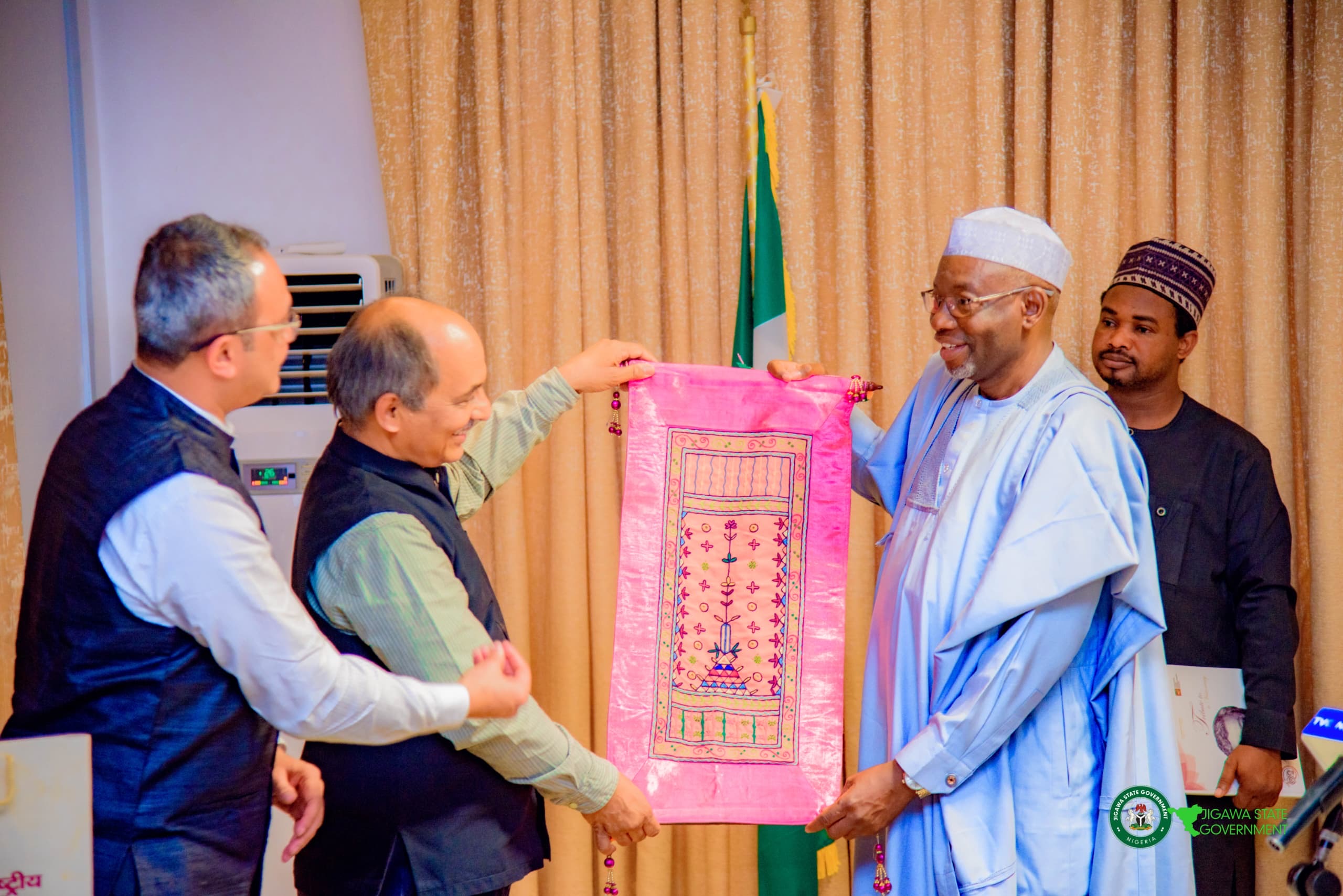
Governor Umar Namadi disclosed this while receiving a high-powered delegation from the Indian dairy agency led by Rajesh O. Gupta during a courtesy visit to Government House in Dutse.
The governor explained that the visit followed earlier discussions initiated during his official trip to India last year, where he engaged with the leadership of the National Dairy Development Board on possible areas of collaboration to transform the livestock sector in the northwestern Nigerian state.
According to Namadi, the arrival of the NDDB delegation was a fulfillment of the agreement reached during that engagement and a critical step toward building a structured partnership that could reposition the state’s dairy industry and improve the livelihoods of farmers and pastoral communities.
He described the visit as significant to the agricultural development agenda of the state, stressing that the government is committed to adopting practical models that can raise productivity in the livestock sector.
The governor noted that similarities in climatic conditions between Nigeria and India make it feasible for the state to adapt India’s successful dairy development strategies without facing major environmental constraints.
He added that lessons from India’s cooperative-driven dairy model could play a crucial role in transforming Jigawa’s milk production system, particularly by strengthening farmer organizations and improving access to modern livestock technologies.
Namadi observed that the National Dairy Development Board had successfully transformed India’s dairy industry, helping the country emerge as the world’s largest producer of milk.
He emphasized that improving livestock genetics through cross-breeding and artificial insemination could dramatically increase milk yields among cattle in Jigawa, where many cows currently produce very low quantities of milk.
According to the governor, boosting dairy productivity through improved breeds would significantly increase milk output and create new economic opportunities for rural communities.
Namadi also reaffirmed the state government’s readiness to invest in knowledge transfer and capacity development to support reforms in the livestock sector.
He said the government is prepared to sponsor local scientists and extension workers to India for specialized training in dairy science and livestock management, noting that knowledge sharing will be critical to sustaining the planned reforms.
The governor pointed out that India’s extensive network of scientists and agricultural extension officers supporting farmers demonstrates a model that could be replicated to strengthen agricultural advisory services in the state.
He further assured the delegation that the Jigawa State Government is eager to accelerate the partnership process and expects a comprehensive proposal from the NDDB to guide the next phase of collaboration.
Namadi said the state administration hopes to receive the proposal before the end of March or early April, after which concrete steps would be taken to implement the partnership.
Earlier, Gupta commended the Jigawa government for the opportunity given to the NDDB delegation to visit the state and examine its livestock ecosystem.
He revealed that the team conducted field visits across different locations in the state during a two-day assessment, which provided insights into existing livestock management practices and potential opportunities for dairy sector development.
Gupta explained that India’s success in dairy production was achieved through sustained investments across the entire value chain, including animal breeding, farmer organization, milk processing, and the deployment of modern technologies.
He added that India currently produces about 247 million metric tons of milk annually, making it the world’s leading milk producer.
The NDDB delegation also expressed readiness to support Jigawa through technical cooperation, capacity building for scientists and extension workers, and the development of pilot dairy projects that could serve as demonstration models for broader expansion of the dairy industry across the state.
