

By Abdullahi Lukman
The Federal Government has unveiled plans to establish state-specific Livestock Development Centres to transform Nigeria’s livestock industry and raise its contribution to the economy from $32 billion to at least $74 billion by 2035.
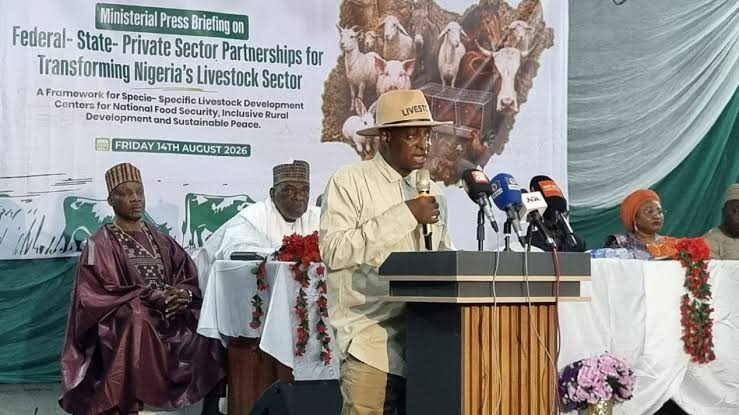
Minister of Livestock Development Idi Maiha disclosed the plan during a press briefing in Abuja, on Friday saying the initiative would be driven through partnerships among the federal government, state governments, producers and private investors.
The centres are designed to implement the National Livestock Growth Acceleration Strategy, a 10-pillar framework approved by the National Economic Council to address major challenges in the sector and attract large-scale private investment.
Under the model, each state will determine the livestock species or value chain it wants to prioritise based on its resources, agro-ecology, producer base, market demand, infrastructure and investment potential. The government said the approach would prevent a uniform livestock policy from being imposed across the country.
The Federal Ministry of Livestock Development will provide national policies, technical standards, animal-health and food-safety protocols, regulatory coordination, data systems and investor facilitation. States, meanwhile, will provide land, local infrastructure, community engagement, security coordination and producer mobilisation.
Private investors, producers and cooperatives will finance and operate commercial activities within the centres, which may include feed production, breeding, dairy processing, livestock finishing, meat processing, cold-chain logistics, animal health, leather production, biogas and organic fertiliser.
Maiha stressed that the centres would not be government-owned farms or standalone construction projects but commercially oriented platforms designed to attract investment across livestock value chains.
The minister said the state-based approach was necessary because livestock production and major consumer markets are geographically uneven. While northern states have larger livestock populations, southern Nigeria represents a major market, creating challenges and risks associated with transporting live animals over long distances.
He said states should therefore develop investment plans based on their comparative advantages and local demand rather than relying on a single national livestock model.
The initiative is expected to address challenges including poor animal genetics, inadequate water and feed supplies, limited veterinary and extension services, insecurity, weak infrastructure, land-use constraints, high input costs and insufficient private investment.
Maiha cited proposed and ongoing projects including a 15,000-hectare livestock development centre in Ubahu-Nkanu East, Enugu State, focused on cattle ranching, dairy and leather; the MilkyWay Dairy in Plateau State; the 900-hectare Niegev Goat Ranch in Benue State; the N120 billion Gombe State Livestock Development Centre; and the Mafa Livestock Development Village in Borno State.
The government also said women and young people would be encouraged to participate in enterprise ownership, value addition and service delivery rather than being confined to short-term training or low-value activities.
According to Maiha, the success of the livestock transformation agenda will depend on a coordinated federal, state and private-sector partnership that combines national standards and support with state-level resources and private capital.
