

By Abdullahi Lukman
The Federal Government has reaffirmed its commitment to expanding Nigeria’s cocoa industry while ensuring compliance with the European Union Deforestation Regulation (EUDR), positioning cocoa as a key pillar in economic diversification, job creation, and sustainable trade.
Speaking at the Nigeria-EU Cocoa Roundtable on EUDR Compliance held Monday in Abuja, Kingsley Uzoma, Senior Special Assistant to the President on Agribusiness and Productivity Enhancement, emphasized cocoa’s strategic role in the non-oil export sector.
“Cocoa is now a strategic lever in Nigeria’s economic transformation,” he said, citing its contribution to 29 percent of agricultural exports and 5.6 percent of non-oil exports.
According to the National Bureau of Statistics, cocoa exports surged by 606 percent in Q4 2024, rising from N171 billion in late 2023 to N1.2 trillion — a growth attributed to strong global demand and the resilience of Nigeria’s agricultural sector.
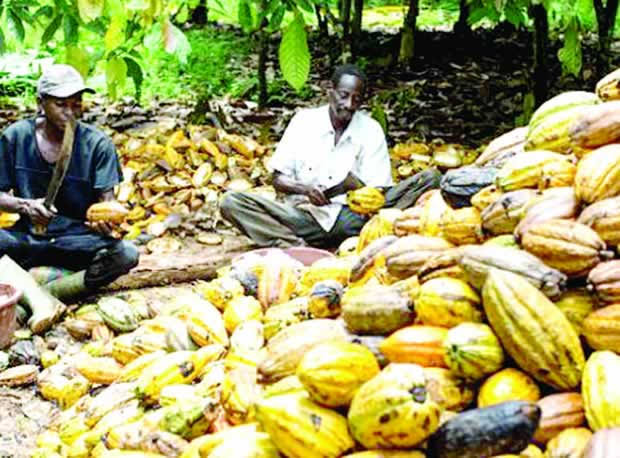
Uzoma noted that over 300,000 smallholder farmers drive the sector, producing 80 percent of Nigeria’s cocoa output.
The country aims to hit 500,000 tonnes of cocoa production by 2025.
However, he warned that achieving full EUDR compliance requires improved financing and infrastructure, advocating for a dedicated credit line with flexible repayment terms.
EUDR mandates traceability, due diligence, and deforestation-free supply chains.
Uzoma said these requirements align with Nigeria’s green economy agenda and are spurring innovations like blockchain, satellite mapping, and farmer support programs that boost yields without deforestation.
Institutionally, efforts are underway to designate a government agency for cocoa sector data management and to enhance collaboration with the Raw Materials Research and Development Council for research across the cocoa value chain.
He also highlighted the opportunity for increased private investment in cocoa processing zones and traceability infrastructure, as well as potential access to climate finance and carbon credit schemes.
Minister of Trade and Investment, Olajumoke Oduwole, also addressed the event, emphasizing the role of space technology in traceability and productivity.
She noted that Nigeria’s space agency now supports over 5,000 sites and 350 agricultural products through advanced satellite imagery.
Oduwole reiterated that with the EU accounting for over 60 percent of Nigeria’s cocoa exports, EUDR compliance is a necessity.
She described it as both a challenge and a chance to grow foreign exchange earnings, create jobs, and help meet the administration’s $1 trillion economy goal under the Renewed Hope Agenda.
Uzoma declared Nigeria “ready and resolute” to lead in sustainable agribusiness, urging strategic partnerships to turn Nigerian cocoa into a global symbol of sustainability and innovation.
