

By Abdullahi Lukman
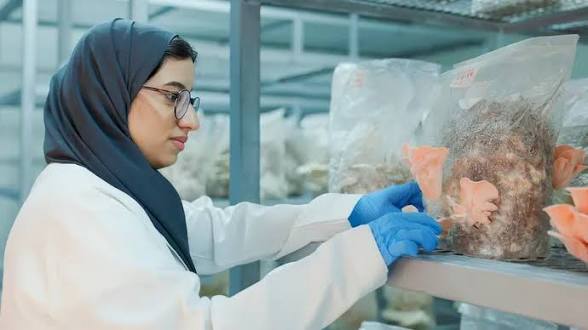
United Arab Emirates University has launched a Smart Mushroom House at its Al Foah Research Farm in the Al Ain region, aimed at producing mushrooms using recycled date palm waste and other biological materials.
The facility uses Internet of Things (IoT) technology to control temperature, humidity, lighting, and ventilation, enabling efficient cultivation in arid conditions.
It features three smart growing units and a central incubator, allowing multiple mushroom species to be produced simultaneously under controlled environments.
Developed by the university’s College of Agriculture and Veterinary Medicine in collaboration with the University of Malaya, the project is part of a broader initiative focused on date palm waste management and food security in dryland regions.
Each production cycle can handle up to 600 mushroom bags, using nearly three tonnes of substrate, with expected yields ranging between 20 and 30 per cent depending on the species.
Current research includes oyster mushrooms, lion’s mane, Ganoderma, and king oyster mushrooms, alongside efforts to cultivate native desert truffles locally known as Faqa and Zubaidi.
The project is led by researcher Shyam Kurup and supported by a team of scientists and students.
It currently contributes to several academic research projects, including doctoral and undergraduate studies focused on improving production methods and adapting substrates to local environmental conditions.
Beyond cultivation, the facility is also exploring value-added applications such as mycelium-based foods, edible packaging materials, and the conversion of mushroom waste into biochar.
The initiative aligns with the UAE’s National Food Security Strategy 2051, promoting sustainable agriculture through local resource utilisation and circular economy practices.
It also serves as a training hub for students and farmers, supporting knowledge transfer and practical skills in sustainable food production.
