

By Abdullahi Lukman
President Bola Ahmed Tinubu has urged immediate and coordinated measures to tackle flooding across Nigeria, following projections that thousands of communities could be affected in 2026.
The President made the call during the unveiling of the 2026 Annual Flood Outlook by the Nigeria Hydrological Services Agency at the Presidential Villa in Abuja, warning that flooding remains a persistent threat to lives, livelihoods and food production.
He emphasized that flood control is central to his administration’s food security agenda.
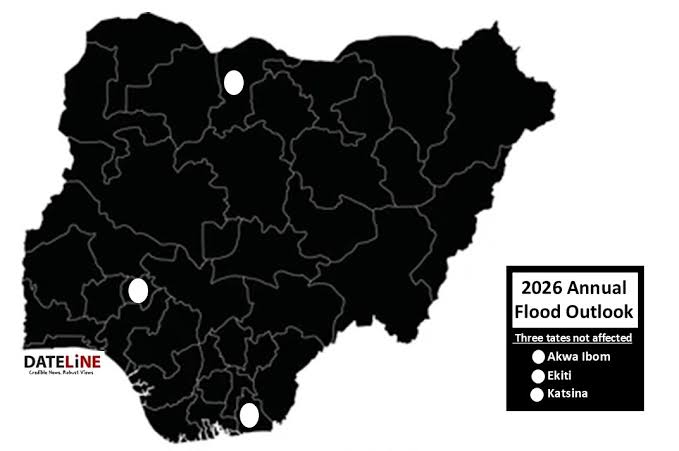
Minister of Water Resources and Sanitation, Joseph Terlumun Utsev, disclosed that the outlook identified 15,597 communities in 405 local government areas across 35 states and the Federal Capital Territory as facing moderate flood risk.
He added that 14,118 communities in 266 local government areas fall within high-risk zones, while 923 communities are considered low risk.
According to Utsev, flooding is expected to peak between July and September, with impacts likely spanning April to November.
He warned that major cities such as Abuja, Lagos, Ibadan and Port Harcourt may experience flash floods due to heavy rainfall, poor drainage and rapid urbanisation. Coastal states including Bayelsa, Delta, Lagos and Rivers also face risks from rising sea levels and tidal surges.
Tinubu noted that interventions have already been carried out in vulnerable states such as Benue, Kogi, Bayelsa, Rivers and Adamawa. He described the 2024 Maiduguri flood disaster as a turning point that prompted a shift toward proactive flood management.
He added that ongoing efforts, coordinated by the Office of the Vice President alongside security agencies and development partners, are focused on prevention.
The President also directed relevant ministries to develop strategies for better utilisation of water resources to support sustainable development.
Utsev urged state governments, local authorities and residents in at-risk areas to begin early preparations, noting that the Federal Government is strengthening flood forecasting through improved hydrological monitoring and closer collaboration with the Nigerian Meteorological Agency.
Director-General of the Nigeria Hydrological Services Agency, Umar Ibrahim Mohammed, described the outlook as a vital planning tool, stating that it was developed using enhanced data-driven methods to identify high-risk and vulnerable urban areas.
He added that the agency has upgraded its flood monitoring dashboard into a real-time decision-support system and introduced a mobile application to improve public access to flood alerts, alongside deploying flood marshals to assist users.
Mohammed called on stakeholders to take the forecast seriously and act promptly to minimise the impact of flooding on vulnerable communities.
