

By Abbas Nazil
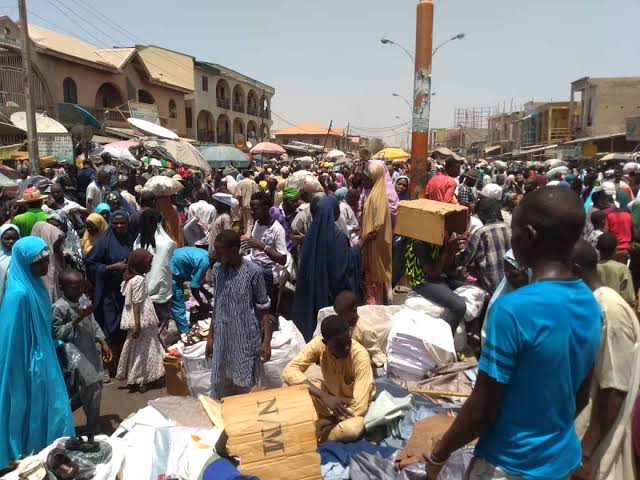
Kano’s rapidly growing population and increasing human activities are putting mounting pressure on the environment, with residents and traders in major commercial areas expressing concern that overcrowding is worsening environmental conditions.
Speaking with a NatureNews reporter during a reporting trip across Kano, residents and traders at Kwari Cloth Market, Singa Market, Batta and Janguza said the rising concentration of people and economic activities was contributing to congestion, increased waste generation, reduced open spaces and growing pressure on the environment.
Abdullahi Musa, a trader at Kwari Cloth Market, told the NatureNews reporter that the large number of people conducting business in the area had increased pressure on the environment.
“Population growth has changed the environment significantly. When many people live and conduct their activities in one place, there will be more vehicles, more waste, more buildings and more pressure on the environment,” Musa said.
At Singa Market, Aisha Sani, a trader, expressed concern about the increasing concentration of people and commercial activities.
According to Sani, the large number of traders, customers, vehicles and other activities around the market had made the area increasingly congested.
“The population is increasing every day, and you can see the effect around us. There is more congestion, more waste and less open space,” she told the NatureNews reporter.
Ibrahim Ahmad, who spoke with _NatureNews_ in Batta, said the increasing population was placing pressure on available land and environmental resources.
Ahmad said the situation required stronger urban planning and environmental management to ensure that population growth did not worsen environmental problems.
At Janguza, Kabiru Yusuf, a trader, said the expansion of human activities was changing the physical environment.
“The more people we have, the more activities we have. There are more houses, more vehicles, more businesses and more waste,” Yusuf told the NatureNews reporter.
Hauwa Ibrahim, another trader at Kwari Cloth Market, called for greater attention to waste management and the provision of green spaces in densely populated parts of Kano.
Ibrahim said planting more trees and protecting existing vegetation could help improve environmental conditions while providing shade and helping communities cope with rising temperatures.
Usman Bello, who spoke with the NatureNews reporter at Singa Market, said population growth should not necessarily be regarded as the direct cause of climate change, but the activities associated with a large population could increase environmental pressure.
“People need houses, transportation, energy and other things. If these activities are not properly managed, they can affect the environment,” Bello said.
Fatima Abdullahi, who spoke with NatureNews in Janguza, also called for stronger environmental awareness among residents, particularly on waste disposal, tree planting and maintaining clean surroundings.
She urged government authorities to improve urban planning and ensure that population growth was accompanied by adequate infrastructure and environmental protection.
The concerns became particularly noticeable during the NatureNews reporter’s journey from Kogi State through Abuja and Kano to Jigawa State.
Travelling through the different locations, parts of Jigawa appeared comparatively less congested and noticeably calmer than the densely populated commercial areas encountered in Kano.
The difference provided a field observation of how population density and the intensity of human activities can influence environmental conditions in different locations.
However, population size alone does not determine whether an area is hotter or cooler, as local temperature and climate are also influenced by vegetation, land cover, humidity, wind, rainfall, geographical location and other factors.
The concerns raised by interviewees nevertheless highlight the need for Kano to strengthen environmental management as its population and economic activities continue to expand.
Rapid urbanisation and poorly planned development can increase pressure on natural resources, waste management systems, transportation networks and urban vegetation.
For Kano, the traders and residents interviewed by NatureNews called for increased tree planting, protection of green spaces, improved waste collection, better urban planning and stronger environmental awareness to reduce the pressure associated with population growth.
They also urged residents to take greater responsibility for their surroundings, saying environmental protection should not be left to government alone.
As Kano continues to experience population growth and expanding economic activities, stakeholders said sustainable urban planning would be essential to ensure that development does not come at the expense of environmental quality and the wellbeing of residents.
