

By Abdullahi Lukman
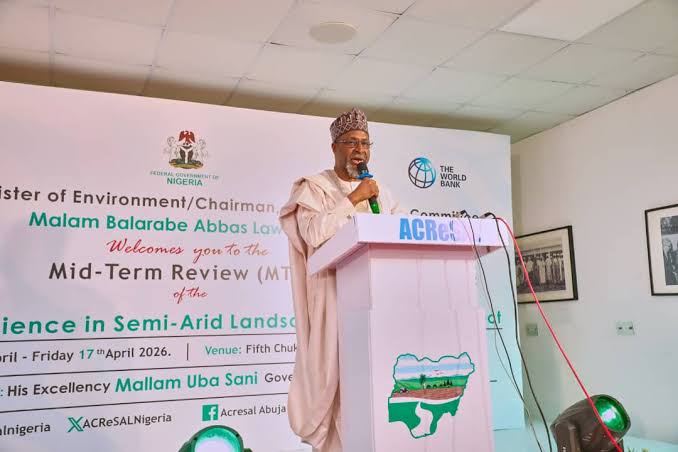
Nigeria’s Agro-Climatic Resilience in Semi-Arid Landscapes (ACReSAL) project has been positioned as a global model for climate resilience and integrated landscape management following its mid-term review held April 16–17, 2026, in Kaduna.
The high-level review brought together federal ministers, state commissioners from 19 northern states and the FCT, World Bank officials, and senior government representatives to assess progress in tackling desertification and strengthening food systems.
Officials reported significant achievements, including the restoration of over 22,000 hectares of land and the desilting of 160 kilometres of drainage systems in Kaduna State to address urban flooding.
The project has also supported climate-smart agriculture through community financing initiatives and trained 500 women and youths in sustainable energy practices.
Speaking at the event, government representatives emphasized that the review marked a critical point in the project’s lifecycle, calling for increased accountability, stronger implementation, and a shift toward practical problem-solving in its second phase.
Stakeholders highlighted the importance of integrating water resource management into land-use planning, noting the link between environmental degradation and water scarcity.
They also stressed the need to expand access to climate-resilient farming inputs to boost food security for smallholder farmers.
Legislators reaffirmed their commitment to oversight and transparency, while development partners described the initiative as a model now being studied across Africa for its collaborative approach between federal and state governments.
The World Bank commended the programme’s
progress, describing it as a blueprint for global best practices in landscape management.
As the project moves toward its 2028 target, discussions focused on securing additional financing to scale impact and potentially extend implementation.
A sustainability framework was also outlined to ensure long-term maintenance of restored landscapes and improved livelihoods beyond the project’s duration.
