

By Abdullahi Lukman
Vice President Kashim Shettima on Friday, June 20, called for deeper collaboration with international partners to address the growing humanitarian and environmental challenges affecting crisis-hit regions across Nigeria.
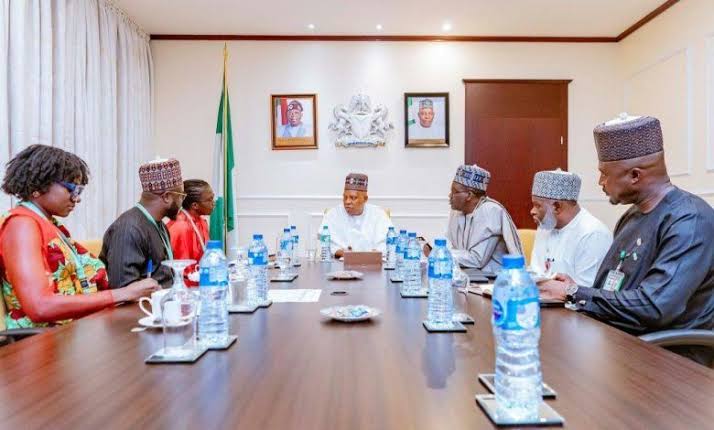
He made the call during a courtesy visit by a delegation from the International Organisation for Migration (IOM), led by its Chief of Mission in Nigeria, Sharon Dimanche, at the Presidential Villa in Abuja.
Shettima emphasized the urgent need for comprehensive and inclusive solutions to the interconnected issues of climate change, migration, poverty, and insecurity.
“There is a strong relationship between ecology and economy in sub-Saharan Africa. You cannot separate the challenges of migration from climate-induced effects,” he said.
He urged the IOM to expand its interventions, particularly in the North Central region, and support efforts in gender empowerment and land restoration in areas affected by displacement and environmental degradation.
Quoting civil rights leader Martin Luther King Jr., the Vice President called for national unity in the face of shared challenges.
“We must either learn to live together as brothers or perish together as fools,” he stated.
In her remarks, IOM Nigeria Chief of Mission Sharon Dimanche commended Nigeria’s progress in migration governance and disaster preparedness, noting the country’s diversity as both a challenge and an opportunity for tailored responses.
“Since I arrived in Nigeria, I’ve been impressed by the government’s commitment, especially through the launch of the State Action Plan on Floods and the Framework for Anticipatory Action,” Dimanche said.
She reaffirmed the IOM’s commitment to supporting Nigeria’s efforts through data provision, youth empowerment, shelter support, and climate resilience.
She also sought closer cooperation with the Vice President’s office to mobilize resources and co-design sustainable solutions for communities affected by crisis.
The meeting highlighted the need for stronger, coordinated responses to address the root causes of displacement and promote long-term stability across Nigeria.
