

By Faridat Salifu
Nigeria’s renewable energy sector offers significant opportunities for women-led businesses and agriculture.
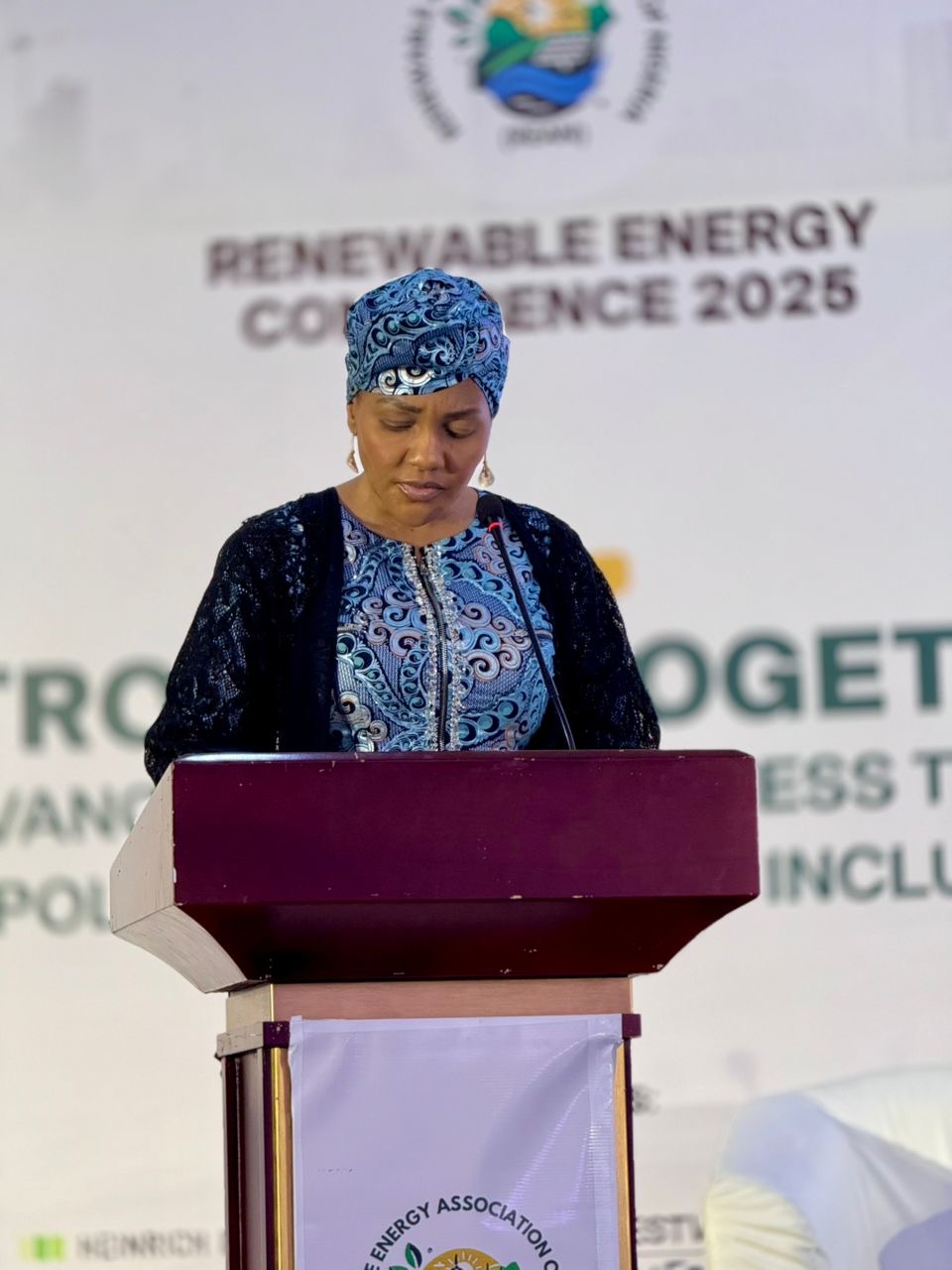
Princess Zahrah Mustapha Audu, Director-General of the Presidential Enabling Business Environment Council (PEBEC), urged greater coordination among regulatory agencies to strengthen the renewable energy ecosystem.
Speaking at the Renewable Energy Conference themed “Stronger Together: Advancing Energy Access through Policy, Finance and Inclusion,” held on Tuesday In Abuja, she highlighted PEBEC’s commitment to enabling businesses across sectors.
Princess Zahrah encouraged women to equip themselves with knowledge and engagement, noting that renewable energy is accessible to individuals of all educational backgrounds.
She emphasized that men in Nigeria are not inherently more equipped for the sector, and women should focus on building expertise and relevance.
PEBEC does not have policies specifically targeting women, but it implements frameworks that make it easier for all businesses to thrive.
The council prioritizes foreign investors, multinationals, and programs like the RISF in its support for business growth.
Princess Zahrah explained that PEBEC supervises 59 federal ministries, departments, and agencies, as well as all state governments.
Business councils have been established at sub-national levels to facilitate regulatory oversight and collaboration.
She highlighted reforms such as streamlining overlapping roles among agencies like NAFTA and CANSON, backed by memoranda of understanding for joint inspections.
PHS code reporting has also been improved to support renewable energy assemblers who primarily import raw materials.
PEBEC aims to reduce import dwell time from 21 days to seven by the end of 2026 using technology and National Security Bureau support.
Princess Zahrah stressed the importance of inter-agency communication to break silos and reduce duplication and inefficiency.
David Arinze, Renewable Energy Specialist, highlighted solar-powered technologies transforming Nigeria’s agriculture sector.
Solar-powered irrigation pumps provide off-grid water for small- and medium-scale farms while reducing fuel costs and greenhouse gas emissions.
These pumps enable year-round farming, increase cropping cycles, and support women and youth engagement in agriculture.
Solar-powered cold storage units extend produce shelf-life by up to 21 days and are suitable for off-grid areas.
Solar dryers allow controlled off-grid drying of vegetables, fruits, grains, and fish, improving hygiene, reducing losses, and increasing incomes.
Biogas digesters convert agricultural waste into electricity and nutrient-rich fertilizer, cutting costs and creating income opportunities.
Challenges include post-harvest losses, deforestation, fossil-fuel dependence, labor inefficiency, water scarcity, and weak agricultural value chains.
Barriers to adoption include low awareness, limited financing, maintenance gaps, and poor integration with markets.
Recommendations include a national Clean AgTech policy, dedicated financing, rural infrastructure investment, and gender-inclusive programming.
Digital tools such as mobile climate advisories and digital marketplaces can improve resilience, market access, and adoption of clean technologies.
Shalom Merari, business analyst, conducted and presented an energy audit of 1,000 female-led micro and small enterprises (MSEs) in Abuja and Lagos.
The audit assessed energy consumption, costs, equipment profiles, and readiness for solar energy integration.
Findings show that many MSEs spend up to 33 percent of monthly revenue on electricity and generator fuel, with over half relying on generators for 1–8 hours daily.
Nearly half of these businesses earn less than N200,000 monthly, yet 95.6 percent are technically and financially ready to adopt solar energy.
Most MSEs already own equipment compatible with solar systems, making them ideal candidates for small- to medium-scale installations.
Recommended deployment models include pay-as-you-go (PAYG) or lease-to-own systems with monthly payments aligned to current energy spending.
Gender-sensitive strategies are critical, as decision-making on technology often rests with men even in women-led businesses.
Joint training, community demonstrations, showcasing female energy entrepreneurs, and technical capacity building can improve adoption.
Policy measures such as concessional loans, tax incentives, bulk procurement, and cooperative-based aggregation can support solar adoption.
Renewable energy providers are urged to deliver tailored solutions with training, remote monitoring, and responsive after-sales service.
Development partners and financiers should provide dedicated credit lines, grants, technical assistance, and risk-sharing mechanisms.
Empowering women entrepreneurs and rural farmers with affordable, reliable clean energy could unlock up to N15 trillion in economic potential, create jobs, and advance sustainable development goals in Nigeria.
