

By Obiabin Onukwugha and Abbas Nazil
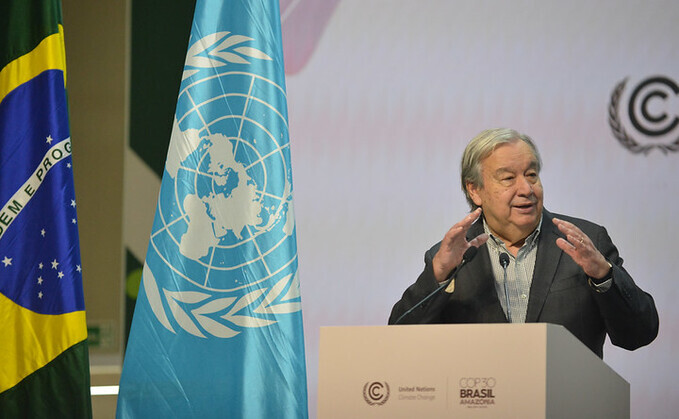
United Nations Secretary-General, António Guterres, has called on global leaders to stop treating the transition away from fossil fuels as ‘taboo’, saying delay will only breed instability.
According to Guterres, renewables are now the cheapest, fastest, and safest source of new electricity almost everywhere.
Guterres made the call at the 2026 International Energy Agency (IEA) Ministerial Meeting, which took place in Paris between Wednesday and Thursday.
He stated that last year, $2 trillion flowed into clean energy, nearly twice as much as into fossil fuels, noting, “Yet some fossil fuel interests remain hell-bent on slowing progress; spreading disinformation; pretending that a transition is unrealistic or unaffordable.”
Guterres stressed that three fourths of humanity lives in countries that are net importers of fossil fuels; “dependent on energy they do not control, at prices they cannot predict; watching development budgets siphoned into fuel bills; at the constant mercy of geopolitical turmoil and supply disruptions.”
He told the forum that the shift from fossil fuels must be fair, orderly, affordable, and aligned with 1.5°C, protecting workers and communities and connecting hundreds of millions of people to modern energy services.
“That is why today, I am calling for a dedicated global platform for honest dialogue on transitioning away from fossil fuels. This platform must bring together producers and consumers, developed and developing countries, public and private financial institutions, and civil society.
“It must be a space to sequence the decline of fossil fuel investment with the rapid scale-up of clean energy and to deliver a global transition plan that aligns investment, energy security and climate goals with concrete milestones and robust finance, particularly for developing countries,” the UN chief stated.
The dialogue focuses on discussing strategies to expand access to energy for all and accelerate the implementation of clean cooking energy solutions.
The forum also forms part of global efforts to address the challenges of climate change and ensure access to sustainable energy for economic and social development.
Meanwhile, Nigeria Climate Justice Alliance has reaffirmed its commitment to advancing climate justice as it concluded a two-day policy review workshop in Abuja.
In a communique issued at the end of its 2026–2030 Strategic Action Plan Review and Coordination Workshop, the civil society-led coalition pledged to strengthen community voices, protect ecosystems, promote equity and hold duty-bearers accountable for climate action.
The communique was jointly signed by Dr. Joseph Onoja of Nigeria Conservation Foundation, Dr. Michael David of Global Initiative for Food Security and Ecosystem Preservation and Dr. Grace Alawa of Sustainable Action for Nature, alongside other civil society leaders.
The alliance stated that it would intensify efforts to influence policy processes and support inclusive and sustainable responses to climate change across Nigeria.
According to the coalition, climate change continues to worsen social and economic inequalities, with frontline and low-resilience communities bearing the heaviest burden of its impacts.
It noted that women, youth, and local communities are often driven into livelihood activities such as deforestation due to limited economic options, inadvertently worsening environmental degradation, and deepening their vulnerability.
The group identified weak coordination among civil society actors as a major obstacle that has limited collective influence on climate policy formulation and restricted equitable access to climate finance.
To address this, members agreed that the newly reviewed strategic action plan would serve as a framework to strengthen collaboration, improve coordination, and scale up collective advocacy.
The coalition emphasised the need to transition towards people-centred and community-led climate solutions that prioritise the most vulnerable populations while tackling the structural causes of inequality.
It further resolved that civil society organisations and social enterprises must avoid working in isolation and instead consolidate efforts under a shared vision for climate justice.
The alliance underscored that true climate justice must integrate gender inclusivity and ensure the participation of persons with disabilities in climate decision-making processes.
NCJA called on government institutions, development partners, the private sector, and the media to support transparent and inclusive climate action in Nigeria.
Members also agreed to strengthen governance and accountability structures within the coalition, establish functional working committees on advocacy, resource mobilisation, knowledge sharing and capacity building, and develop a joint action roadmap with clear priorities and timelines.
Through coordinated advocacy, strategic partnerships, and joint resource mobilisation, the alliance aims to amplify community voices and promote a just transition toward a more resilient and equitable climate future for Nigeria.
