
Special Report: Orashi communities taste climate-driven floods, bear brunt of government failure


Erractic weather conditions propelled by climate change impacts have persistently orchestrated flooding around Orashi River in Rivers State, plunging the surrounding communities, especially old people and children along the river to displacements, debilitating hardships and death.
Mrs Juanah Opuwill, is a poor farmer from Ikodi-Engenni community, Ahoada West local government area of Rivers State.
When NatureNews reporter visited Ikodi community in September, Mrs. Opuwill was peeling premature cassava she harvested from her farm.
On yearly basis her crops are destroyed by flood from the Orashi River. In order to save a little for herself and grandchildren, she harvests her cassava premature.
“Our cassava is yet to mature but because of flooding, we harvest early so that we don’t lose everything,” she said, “This is what we face in this community every year.”
The Octogenarian, who spoke through an interpreter, lamented the hunger and hardships she and her family face during and after flooding.
“We don’t have any option. If we don’t harvest now we will lose everything”, she told NatureNews reporter.
Orashi communities bear the brunt of climate change impacts.
Opuwill’s story is the stark reality faced by old people and children during flooding in these communities.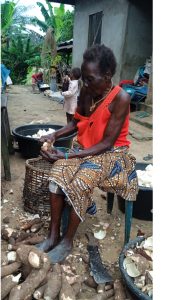
From June every year, flood-prone communities along the Orashi River, including Abua/Odual, Ahoada East, Ahoada West and Ogbia/Egbema/Ndoni local government areas of Rivers State, begin harvesting premature crops because their farmlands become submerged by rain waters and later by monster floods that come through the River Niger and Benue respectively, which lasts till late November.
During this period, unrecorded death rates arising from sicknesses, hunger and other related diseases are usually on the increase.
While a few persons are able to relocate to higher grounds or temporary IDP camps, majority of residents, especially the aged and children, who are mostly vulnerable, live within the communities with their homes submerged.
Besides being exposed to diseases, children become vulnerable and miss school because there are no grounds for them to play, while schools are also shut down.
NatureNews observed that most of these communities lack basic health amenities, while those with primary healthcare centers either lack medical personnel or drugs.
Insert video of 2022 flood in Okolomade community, Abua Odual local government area of Rivers State
Local communities losing trust in government
During the visit by this reporter to the Ikodi-Engenni community, there were lamentations of government neglect and a feeling of mistrust and betrayal by those in government leadership, who they say are supposed to bring succour to them.
The Community Development Committee (CDC) Chairman of Ikodi community, Lazarus Jonah, during an interview session told this reporter the challenges community folks face during flood.
“During flooding we used to suffer many things. When water submerge the community, it is this same water we take our bath, this same water we drink from it, it’s in this same water we toilet, and the water will be polluted,” he said, “From there children will suffer many diseases and sicknesses, people fall sick, but men and women.”
He mentioned that both accomodation and survival become a problem for the people.
“We don’t even have IDP camps here. Some times they tell us to go to Akinima (local government headquarters), or a higher ground to stay.
“The storey buildings we have in this community serve as refuge for us, but it’s difficult to contain everybody. Thirty persons will squat in a room.
“During that period, you cannot wear slippers (footwear), we use cannoe for mobility during flood and we are calling on both the government and relevant authorities to come to our aid,” Jonah lamented.
While the government provides palliatives for impacted commy, they soon run out, exposing vulnerable community folks, especially old people and children to hunger, malnutrition and deaths.
A 2024 report by OCHA revealed that over 320 people died, while 1.3 million were affected by floods in 34 states in Nigeria.
One of the Chiefs from Ikodi community, Augustine Okokimie, recounted that flood have driven many people to indebtedness and untold hunger and hardships because of the loans they obtain for farming.
“Anytime flood comes, we only rest on canoes. We lost our properties. Lives have been lost too, crops, buildings have been destroyed, he said: “our farmlands will submerge, houses will be submerged. Our crops, yam, sweet potato, plantain, plantain, banana.”
“Most of the farmers obtain loans from financial institutions to be repaid but by the time the flood destroys their crops they find it difficult to repay,” Okokomie stated
Government’s weak political will to address flooding
Despite billions of naira spent by the government towards flood mitigation, these monies have failed to address the yearly flooding suffered by communities across Nigeria.
In August this year, the President Bola Tinubu government approved the sum of N3billion for each of the 36 states and the Federal Capital Territory (FCT), totalling N51billion, to tackle flooding.
When these monies are released, they mostly go to palliatives and relief materials, clearing of drainages, and relocating people to higher grounds, an action that has not addressed the problem of flooding in the country.
Felix Ayanado, who just came back from the farm when this reporter visited the Ikodi-Engenni community said panic harvest is an annual event for the community.
“It’s panic harvest and we do it every year”, he said, “Palliative doesn’t help at all. It has not helped us at all. We live by the river bank and we suffer from the flood.”
For Ayanado, the government needs to take decisive steps in addressing the yearly flood menace.
“The government should dredge the river to contain more water volume or they construct canals that will channel the water to the Sombreiro River, where it will empty itself to the ocean,” he stated, “The suffering is getting too much.”
On how he survives with his family, Ayanado said the community have local ways they preserve their processed food. “If we are not able to process all our cassava before the floods, we look for a higher ground to bury the tubers,” said Ayanado, who is in his late sixties. “After the flood we can recover,” he lamented.
Henry Ekine, a lawyer and environmental activist in an interview with our reporter, called on the federal government to embark on dredging of the River Niger and its tributaries, and embankment of the coastline communities.
He argued that the relief materials provided by government during flooding do not sustain families for a long time.
“The problem is that thegovernment do not seem to understand that this is an existential problem affecting their people and to provide sustainable solutions to it.
“During flooding farmlands will be flooded, medical health becomes a problem, sanitation is a problem and course children, sick persons and the elderly become worse victims,” he stated. 
Nigeria boasts over 340 dams spread across different geo-political zones, that could be harnessed to contain more flood waters and increase its hydropower energy access to millions of Nigerians living without electricity.
Obiabin Onukwugha, an investigative reporter on biodiversity, environment, and climate change, is a staff of NatureNews.
