

By Abbas Nazil
Nigeria’s Vice President Kashim Shettima has called for urgent and decisive global action on climate change, warning that the crisis is not only an environmental issue but also a fundamental threat to security, migration, and global stability.
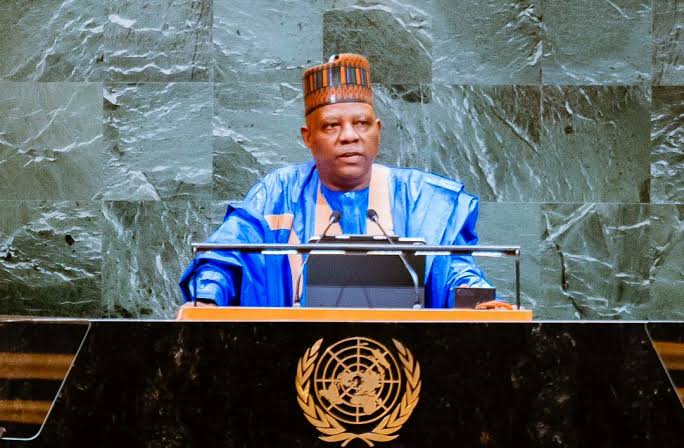
Delivering Nigeria’s statement at the General Debate of the 80th Session of the United Nations General Assembly in New York, Shettima emphasized that climate change must be treated as an “everyone issue” and urged better deployment of climate funds to vulnerable communities.
He said Nigeria has directed relevant ministers to work closely with the UN to ensure climate financing is channeled into education, resilient housing, access to technology, and solutions that enable at-risk populations to thrive rather than become victims of environmental instability.
Shettima stressed that climate action is inseparable from peace and security, noting that irregular migration, resource conflicts, and violent extremism are all fueled by environmental degradation.
The Vice President also urged reforms in global financial systems to promote debt relief and sustainable development, proposing a new binding mechanism akin to an “International Court of Justice for money” that would help emerging economies escape dependence on primary production and unlock industrial growth.
On natural resources, Shettima said countries rich in minerals must benefit directly from them through investment, local processing, and job creation, rather than being trapped in cycles of raw exports and inequality. He argued that inclusive resource management, as seen in Nigeria’s Niger Delta, is essential for stability.
The Nigerian leader also addressed technology, calling for a dedicated global initiative to close the digital divide. He cautioned that while technology offers immense opportunities, unchecked fake news and growing cynicism among youth threaten global trust and stability.
On global governance, Shettima reiterated Nigeria’s demand for a permanent seat on the UN Security Council, arguing that the UN must reflect present realities. He pointed out that Nigeria, now a nation of over 236 million people and a consistent peacekeeping contributor, deserves fair representation in decision-making.
He reaffirmed Nigeria’s support for the two-state solution in the Israeli-Palestinian conflict, describing it as the only dignified path to peace, and rejected any notion that human life should become a bargaining chip in political disputes.
Shettima concluded by declaring that Nigeria remains fully committed to peace, development, multilateralism, and human rights, stressing that “none of us is safe until all of us are safe.”
