

By Abbas Nazil
An estimated 35 million Nigerians are currently living with disabilities, according to a new demographic dataset unveiled in Abuja by the Joint National Association of Persons with Disabilities.
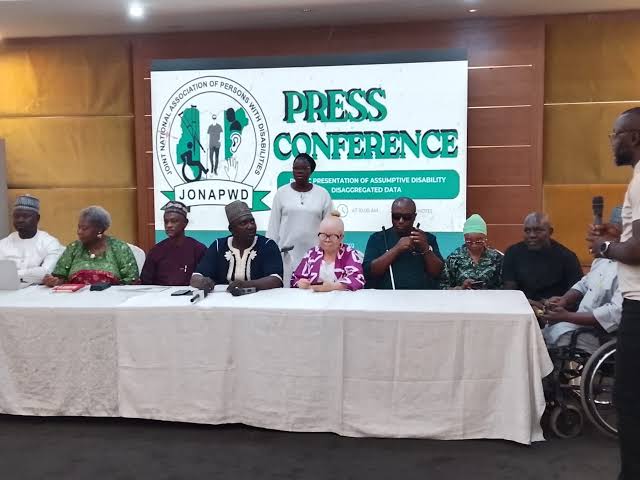
The report, titled “Assumptive Demographic Data on Persons with Disabilities in Nigeria,” was presented during a press conference aimed at providing a working baseline for understanding the size and distribution of persons with disabilities across the country.
According to the association, the estimate was calculated using the global benchmark which assumes that about 15 percent of any country’s population lives with some form of disability.
This percentage was applied to Nigeria’s 2025 population projections provided by the National Population Commission.
Leaders of the disability advocacy group explained that the study was conducted to address the long-standing absence of comprehensive and reliable disability data in Nigeria.
They noted that the lack of accurate statistics has for years limited the ability of governments, development agencies and civil society organisations to design effective programmes or allocate resources properly for persons with disabilities.
President of the Joint National Association of Persons with Disabilities, Abdullahi Aliyu Usman, said the dataset is intended to help policymakers better understand the demographic realities of disability across Nigeria.
He explained that the data provides estimates not only by location but also by disability type and gender distribution.
The analysis indicates that Kano State has the highest estimated number of persons with disabilities in the country, with approximately 2.5 million individuals.
This is followed by Lagos State, where the number is estimated at around 2.1 million.
The report further shows that physical disabilities represent the largest category among persons with disabilities in Nigeria.
About 8.2 million individuals are estimated to be living with physical impairments across the country.
The deaf community forms the second-largest group, with roughly 7.7 million individuals estimated to have hearing impairments.
Other forms of disabilities are also represented in the dataset, although the report highlights that more detailed research will still be required to capture the full complexity of disability categories nationwide.
Gender analysis in the report indicates that male persons with disabilities slightly outnumber females.
The dataset estimates that more than 17.6 million men in Nigeria live with disabilities.
Female persons with disabilities are estimated to number around 17.2 million.
Officials at the unveiling said the report is expected to serve as an important tool for governments, development partners, civil society groups and disability rights advocates.
They believe the data will assist stakeholders in designing policies and interventions that are more inclusive and responsive to the needs of persons with disabilities.
Speaking at the event, the Senior Special Assistant to the President on Special Needs and Equal Opportunities, Mohammed Abba Isa, described the dataset as a major milestone in addressing Nigeria’s long-standing data gap on disability issues.
Representing President Bola Ahmed Tinubu, Isa said the absence of credible and disaggregated statistics has historically been one of the biggest obstacles to effective policy planning for vulnerable populations.
He stated that the new dataset would support the federal government’s effort to build a more comprehensive national database on persons with disabilities and other vulnerable groups.
According to him, the initiative aligns with the administration’s broader inclusive governance strategy known as the Renewed Hope Agenda.
Also speaking at the event, Secretary of the National Population Commission, Adeiyi Onah Daniel, confirmed that the commission has endorsed the findings.
He urged government agencies, development partners and other stakeholders to use the data as a guide when designing programmes and policies targeted at improving the welfare and inclusion of persons with disabilities across Nigeria.
