

By Abbas Nazil
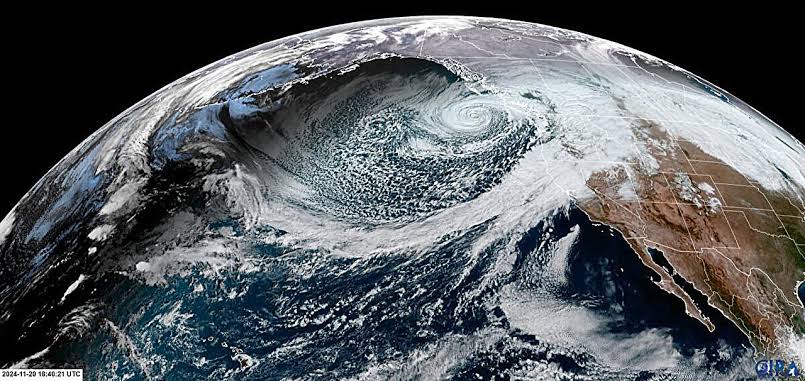
Winter storm tracks over the North Pacific Ocean are shifting poleward at a pace far faster than scientists had anticipated, according to a new study that raises concerns about the reliability of current climate models.
The research links this rapid shift to accelerating climate change and highlights serious implications for both Alaska and the southwestern United States.
Scientists warn that the changes are already reshaping regional climate patterns, intensifying glacier melt in the north while worsening heat, drought, and wildfire risks farther south.
The study, published in the journal Nature, was conducted by Dr. Rei Chemke of the Weizmann Institute of Science and Dr. Janni Yuval of Google Research.
Using long-term satellite observations and atmospheric data, the researchers found that winter storms across the North Pacific are moving northward much faster than projected by existing climate simulations.
These storms play a critical role in transporting heat and moisture from lower latitudes toward the Arctic.
As their paths shift northward, more warmth and moisture are delivered to Alaska, accelerating glacier melt and altering precipitation patterns.
At the same time, regions such as California and Nevada receive fewer cooling storms, reducing natural atmospheric ventilation and allowing heat and dryness to intensify.
Alaska’s glaciers are currently losing an estimated 60 billion tons of ice each year, a rate that continues to increase.
Farther south, record-breaking heat waves and prolonged dry conditions are creating ideal conditions for large and destructive wildfires.
The researchers introduced a new metric based on sea-level pressure, a variable that has been consistently measured for decades.
This approach allowed them to distinguish between natural climate variability and long-term human-driven change.
Their findings indicate that the observed storm-track shift cannot be explained by natural cycles alone.
Instead, the shift is a clear and direct consequence of climate change.
The results add to growing evidence from Chemke’s earlier studies suggesting that storm systems around the world are changing more rapidly than climate models predict.
This discrepancy raises concerns about how well current models can anticipate future regional climate impacts.
Accurate climate predictions are essential for planning, adaptation, and risk reduction, particularly in regions vulnerable to extreme weather.
According to Chemke, the inability of models to capture recent storm-track changes suggests that future climate impacts in western North America could be more severe than expected.
Underestimating these shifts may leave communities unprepared for intensified heat, water shortages, and ecosystem disruption.
The study also highlights the broader challenge facing climate science as rapid environmental changes outpace modeling capabilities.
Storm tracks influence rainfall, temperature, and wind patterns across vast areas, making their accurate representation critical for long-term forecasts.
If models fail to capture these dynamics, policymakers and planners may underestimate risks tied to climate change.
The findings underscore the need to improve climate models using observed data and new analytical methods.
They also reinforce the urgency of reducing greenhouse gas emissions to limit further disruption of Earth’s atmospheric systems.
As evidence mounts that climate change is unfolding faster and in more complex ways than expected, scientists caution that the window for effective adaptation may be narrowing.
