

By Abdullahi Lukman
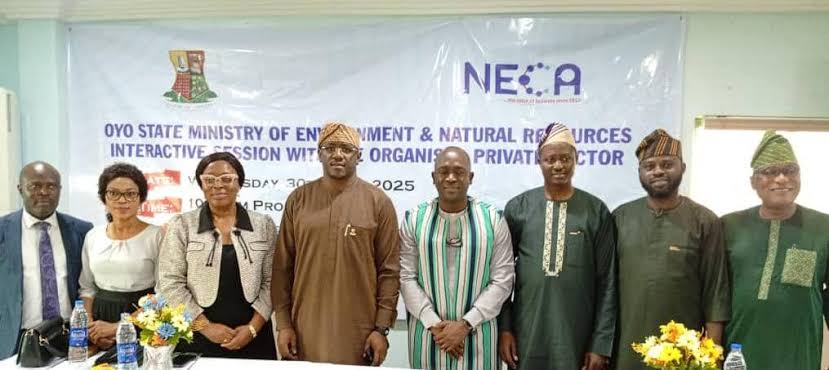
The Nigeria Employers’ Consultative Association (NECA) has formalized a partnership with the Oyo State government to promote sustainable business practices and strengthen environmental governance in the state.
Announced during a stakeholder engagement in Ibadan, the initiative marks a strategic shift toward public–private collaboration in shaping regulatory frameworks that balance economic growth with ecological responsibility.
The forum, themed “Strengthening Public–Private Dialogue for Environmental Sustainability in Oyo State,” brought together policymakers, private sector leaders, and civil society representatives.
NECA Director-General Adewale-Smart Oyerinde described the partnership as part of a broader push to institutionalize dialogue between government and businesses, noting the state’s openness to stakeholder input.
“One of the strongest signs of meaningful collaboration is the government’s willingness to listen,” he said.
Temilolu Ashamu, Oyo State Commissioner for Environment and Natural Resources, reaffirmed the state’s commitment to building a transparent and business-friendly regulatory environment.
He urged businesses to go beyond basic compliance and take active roles in championing sustainability.
At the forum, the Manufacturers Association of Nigeria (MAN) raised concerns over rising operational costs, volatile exchange rates, and limited access to financing.
Southwest MAN representative Sunday Aboriomoh called for improved access to low-interest credit and greater involvement of manufacturers in environmental policymaking.
Beyond immediate economic challenges, the NECA–Oyo partnership is seen as a potential model for sub-national environmental, social, and governance (ESG) integration in Africa.
While countries have committed to global sustainability targets under frameworks like the UN Sustainable Development Goals (SDGs) and AU Agenda 2063, local-level implementation has often been weak due to fragmented coordination and capacity gaps.
Oyo’s approach, centered on co-regulation and continuous stakeholder dialogue, may offer a replicable path for other African states and provinces navigating the intersection of industrial development and environmental responsibility.
As investor scrutiny around ESG intensifies across the continent, the collaboration underscores the role sub-national governments can play in driving Africa’s sustainability transition—from policy formulation to practical implementation on the ground.
