

By Obiabin Onukwugha
It is a spark of new hope for the Ogoni Farmers Network, who are poised to restore their polluted lands and achieve greater crop yield and food sovereignty through agroecologocal practices.
The farmers, with renewed vigour, are using the knowledge gained from a three-day Agroecology Conference that took place at the Nortem community Town hall in Bori, Khana local government area of Rivers State, between September 3rd to 5th September, organised by the Lekeh Development Foundation and funded by the Agroecology Fund.
With the slogan: ‘No Farmer, No Food, the farmers, expressed readiness to achieve food sovereignty and address hunger across Ogoni communities and by extension, Rivers State. They underscored the importance of the conference to their farming, and their readiness to teach other farmers on the importance agroecologocy.
Lauretta Mene, a farmer from Bodo community, described the conference is an eye opener. “The conference has been so helpful because it has to do with agroecologocal system, which has to do with our land, our surroundings and our environment. How good and how best we can make this environment to be beneficial to the people of Ogoni.
“This conference has also helped us to know how we can plant our food crops without chemicals. Our lands that have been polluted without the intervention of the government, how can we revive our lands again. This conference has helped us and given us full knowledge on how we can aid ourselves by restoring the land. It also added that we should go into agro-forestry by planting trees that can give us food.
“As Rivers State is the treasure base of the nation so Ogoni supplies food to Rivers State and for that reason we have to know the importance of our land and how to make our land healthy for proper yield. Now that we’ve gotten this knowledge, we are all going to take this knowledge to our various homes, our villages, our communities, our different localities,” she said.
God’sgift AkieroBari: a farmer from Kaani community, expressed excitement and thanked the Lekeh Development Foundation. She said the benefit of the conference cannot be overemphasized as the knowledge gained has encouraged her to go back into full time farming.
“I am a teacher although I do a little bit of agriculture but this training has exposed me. We were discouraged because the land was barren due to oil exploitation and spillages on our land. When you plant cassava, you can harvest one plot of land without having a basin of garri and it was so discouraging because the aim of every farmer is to make profit.
“But with this program I will be able to treat my soil, using those natural waste I never knew were useful. I’ve been spending money buying fertilisers but I never knew that these waste I throw away can actually help me,” she said.
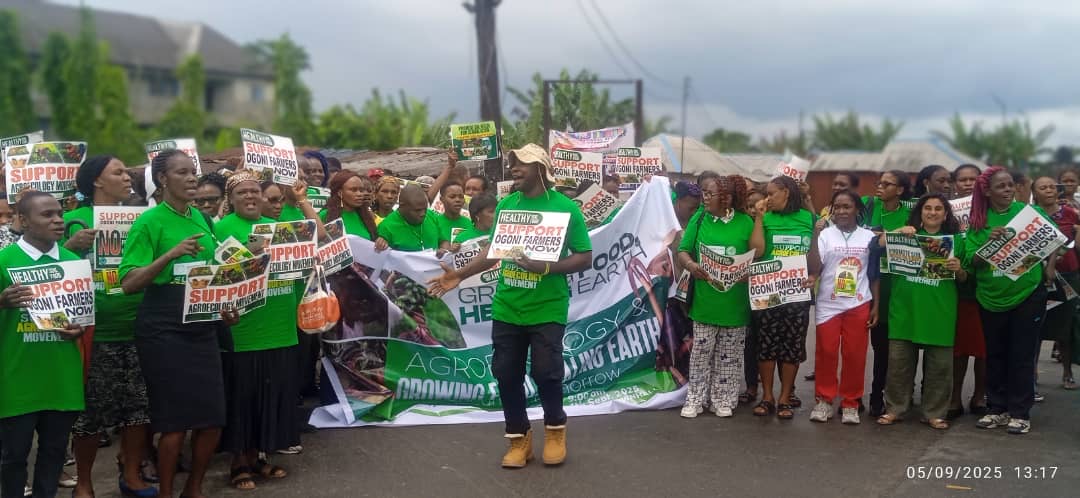
The farmers at the end of the conference, also embarked on a sensitisation walk. Carrying placards with inscriptions: “No Farmers, no food, no future”, “Healthy soil, healthy food, support Ogoni farmers now”, “Support Agroecology Movement”, “Promote Soil Remediation Action”, amongst others, they emphasised the importance of agroecologocy to soil remediation in Ogoniland.
Earlier at the opening session, environmentalists harped on the need for communities to adopt agroecological practices as a way of restoring contaminated soil in Ogoni and African delta communities as a whole.
The Director, Lekeh Development Foundation, (LEDEF), and convener of the conference, Mr. Friday Nbani, emphasised the importance of the conference saying the aim is to provide solution to contaminated soil, through training of farmers on soil remediation and agroecology, instead of waiting for the government and corporations.
“Today we stand on soil that tells a story, a story of resilience, of struggle, and of hope. For over six decades, our Ogoni land has fed families, sustained communities, and connected us to our ancestors. But for those same six decades, oil extraction has poisoned the very earth that gives us life.
“Growing food in our contaminated earth threatens the health of our children. Our farmers watch crop yields decline while pollution spreads, this is not just an environmental crisis this is a crisis of justice, of dignity, of our very future. This project represents something revolutionary combining ancient Ogoni farming wisdom with cutting edge bioremediation science to heal oil contaminated soil through agroecological practices,” he said.
He mentioned that LEDEF is working with the University of Port Harcourt’s Department of Microbiology and its partners in La Via Campesina to train 60 farmers in techniques that can transform poisoned earth back into productive farmland. “These farmers will become village level trainers, spreading knowledge to hundreds more across Ogoni communities.
“We are not just treating symptoms we are addressing root causes through bioremediation composting, crop rotation, and ecological restoration. When we succeed in restoring Ogoni soil, we create a model for delta communities across West Africa facing similar pollution. When we organize farmers into powerful networks, we strengthen the global movement for food sovereignty. When we demand reparations from Shell and other oil companies, we advance justice for all communities harmed by fossil fuel extraction,” the LEDEF director further stated.
He emphasised the need for the communities and their leadership to buy into the program in order for it to sicceed.
“Climate change is accelerating, extreme weather events are intensifying, food insecurity is growing, we cannot wait for governments or corporations to act, we must act now, ourselves, for ourselves.
But we also cannot do this alone that is why partnerships matter. When we restore our soil, we restore our dignity. When we heal our land, we heal our communities. When we build food sovereignty, we build true independence,” Nbani added.
Dr. Emem Okon, executive director, Kabetkache Women Development and Resource Centre: who delivered the Keynote Address titled: “Pollution in Ogoni land: Scientific Evidence and Community Impact”, emphasised that communities must have scientific evidence that link their problems to contaminated soil and polluted environment in order to be able to hold the government and oil corporations accountable.
“Scientific evidence has to do with communities and individuals, having evidence of impact. If we really want to have effective advocacy and campaigns that will benefit the people, we need to begin to put to use, and evidence of how they are impacted by the pollution. Yes we have the UNEP report on Ogoni, we have the report of the Bayelsa Oil and Environment Commission, we need more case studies. We need specific evidence of how women have been impacted, of how men have been impacted, of how children have been impacted.
“Of course when we talk about women, we link children to women. Women have been affected in so many ways outside what the general population of people have been affected. Issues of reproduction is key. So people need to carry out tests to say this is what is happening to me and it is a result of the pollution.
“And this conference is specifically about agroecology, going back to our farmlands, when we also know that the farmlands have been polluted and that the yield of crops, the harvest is not what it should have been. But then we need to test that this cocoayam, this yam, this vegetable, this is what is happening.
“Instead of the food we eat helping us we are are getting hydrocarbon through the food I’m eating. Such evidence is very important and that is also what we need to prove to government that this is what the people are suffering.
“It is also very unfortunate that these days government and corporations are saying that the pollution is caused by the people. So the people are being blamed for what is also affecting them. So let us have evidence to show if it is equipment failure, community knows that this facility in our community, this is what is happening, this was why the spill occured. Let communities begin to document what is happening in their immediate environment,” she stated.
She charged the farmers to make good use of the knowledge they will gain through the program in having scientific evidence of their contaminated, while appreciating LEDEF for organizing the conference.
