

By Abdullahi Lukman
The Nigeria Hydrological Services Agency (NiHSA) has announced major upgrades to its data infrastructure and staff capacity as part of efforts to strengthen the country’s resilience to floods, droughts, and other hydrological hazards.
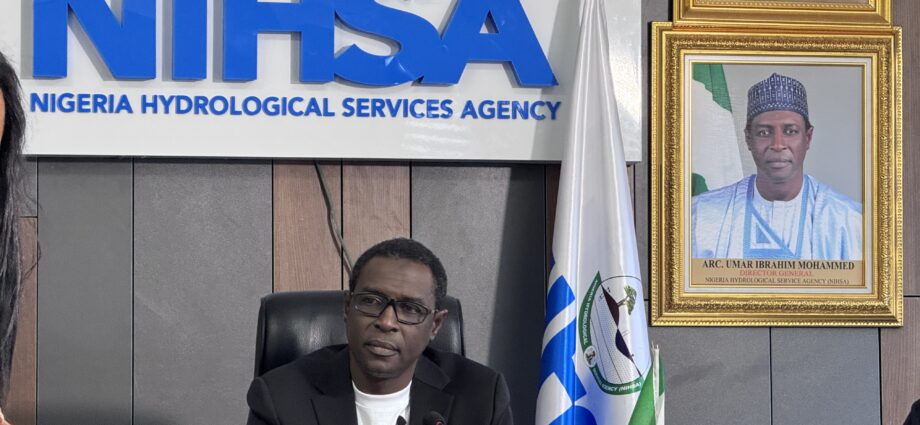
Speaking at a press briefing in Abuja, Director-General Umar Mohammed said the agency had expanded its real-time data collection network and upgraded early warning systems to enhance forecast accuracy and disaster preparedness.
“Our forecasts are now supported by satellite imagery, digital modelling, and ground-based measurements, allowing us to predict and communicate flood risks more effectively,” he said.
NiHSA, as the national authority for water resource monitoring, provides critical data to inform decisions on agriculture, dam operations, environmental management, and emergency response.
Mohammed described the Annual Flood Outlook (AFO) as one of the agency’s key tools, forecasting flood scenarios across all 36 states and the FCT, followed by public sensitisation campaigns.
The agency is also investing in cloud-based data storage and artificial intelligence tools to support real-time monitoring and flood prediction.
NiHSA collaborates with NiMet, NEMA, the National Water Resources Institute, and international organisations such as WMO, UNESCO, and ECOWAS to ensure alignment with global standards and effective emergency coordination.
Mohammed disclosed that current data shows elevated water levels along parts of the Niger and Benue Rivers, with possible localised flooding in Kogi, Anambra, and Delta States.
The DG urged residents in at-risk areas to stay alert and follow official advisories.
Mohammed also highlighted findings from recent flood assessments, which revealed contamination in shallow wells, prompting calls for inter-agency cooperation to ensure access to safe drinking water.
He disclosed that NiHSA is developing a Five-Year Strategic Action Plan focused on innovation, regional engagement, and stakeholder collaboration.
