

By Abbas Nazil
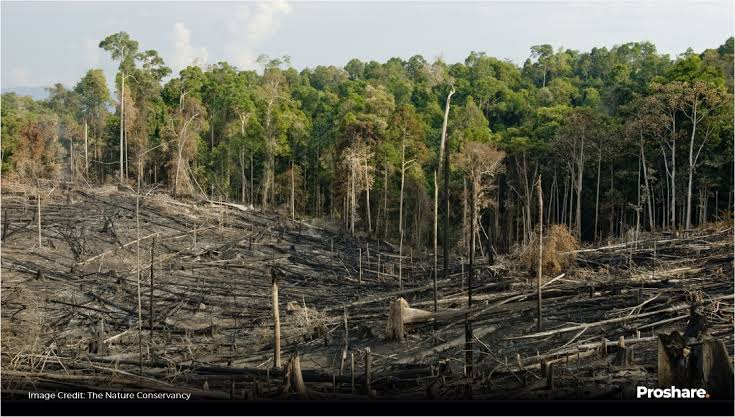
Nigeria is experiencing a severe environmental challenge as deforestation continues at an estimated annual rate of about five percent, placing the country among those with the highest forest loss globally and threatening ecological stability and rural livelihoods.
Forests play a critical role in regulating water cycles, storing carbon, conserving biodiversity, and providing essential resources such as food, medicine, and fuelwood for millions of people across the country.
However, decades of unsustainable logging, agricultural expansion, infrastructure development, and weak regulatory enforcement have significantly reduced forest cover and degraded remaining ecosystems.
Evidence from Southwest Nigeria shows that forest governance systems remain largely revenue-focused, with limited emphasis on regeneration, restoration, and meaningful community participation in decision-making processes.
Large portions of forest land classified as “free areas” operate under unclear tenure arrangements and weak monitoring structures, creating conditions that encourage overexploitation and illegal activities.
At the same time, widespread poverty and energy insecurity continue to drive dependence on fuelwood, which supplies roughly eighty percent of domestic energy needs and contributes directly to ongoing forest depletion.
Agricultural expansion by smallholder farmers remains a dominant cause of forest conversion, as land clearing for cultivation often provides short-term income but results in long-term environmental damage.
The country currently retains approximately twelve percent forest cover, yet more than half of its primary forests have been lost in recent decades, indicating an alarming trend that demands urgent policy intervention.
Nigeria also manages eight national parks and 445 forest reserves, but enforcement gaps and limited funding reduce the effectiveness of protected areas in halting deforestation.
Experts argue that forest conservation must move beyond revenue collection and prioritize ecosystem restoration, stronger legal frameworks, transparent land tenure systems, and active participation of local communities in governance.
They emphasize that sustainable management requires aligning conservation efforts with livelihood support so that communities benefit economically from protecting rather than degrading forest resources.
Environmental advocates warn that continued forest loss could intensify flooding, soil erosion, desertification in northern regions, biodiversity decline, and rising greenhouse gas emissions, further weakening climate resilience.
Forest ecosystems are described as essential ecological infrastructure that supports national development goals, food security, and adaptation to climate change.
Stakeholders therefore call for integrated reforms that combine policy strengthening, renewable energy expansion to reduce fuelwood dependence, and economic incentives that encourage reforestation and sustainable land use.
They also recommend improved monitoring systems, better coordination between federal and state authorities, and enhanced investment in community-based forest management initiatives.
According to forestry experts, shifting from an extraction-oriented model to a stewardship approach is necessary to secure long-term environmental stability and sustainable development.
The future of Nigeria’s forests depends on decisive governance action, stronger enforcement mechanisms, and inclusive participation that balances economic growth with ecological protection.
