
Nigeria takes historic step on climate action, validates just transition, low carbon plan

By Abbas Nazil
Nigeria has officially validated its Just Transition Guidelines and Action Plan (JT-GAP), marking a historic milestone in the nation’s pursuit of a sustainable, low-carbon, and inclusive future.
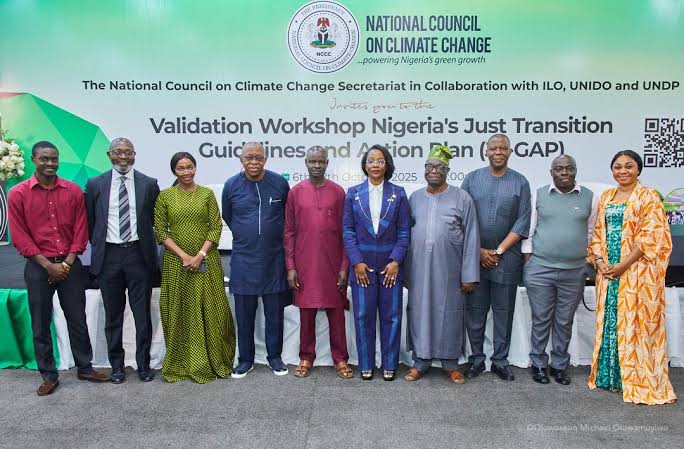
The validation ceremony, held from October 6 to 7, 2025, at the Nigeria Air Force Conference Centre in Abuja, was organised by the National Council on Climate Change (NCCC) with support from the International Labour Organisation (ILO), UNDP, and UNIDO.
The JT-GAP, developed by the Centre for Climate Change and Development (CCCD) at Alex Ekwueme Federal University, Ebonyi State, provides a comprehensive framework to guide Nigeria’s equitable shift toward a green economy.
During the two-day workshop, experts from government institutions, academia, and development partners reviewed the draft document.
Lead consultant Professor Chukwumerije Okereke, represented by Professor Emmanuel Oladipo, and Project Manager Dr. Austine Sadiq Okoh highlighted key themes, including gender inclusion, youth empowerment, and social justice, ensuring the plan’s inclusive foundation.
The Director-General of the NCCC, Mrs. Tenioye Majekodunmi, described the JT-GAP as a “comprehensive, evidence-based document” aligned with Nigeria’s Energy Transition Plan (ETP) and Nationally Determined Contributions (NDCs).
She emphasized that the plan reinforces Nigeria’s vision of a people-centered transition that integrates economic growth, social justice, and environmental sustainability.
Majekodunmi urged all stakeholders to ensure the plan’s swift implementation, stressing that the Just Transition is not only an environmental goal but a developmental pathway that ensures “no one is left behind.”
Participants, including representatives from ministries, development partners, civil society, youth groups, labor unions, and persons with disabilities, praised the inclusivity and quality of the document.
Professor Okereke commended Nigeria’s leadership in embedding fairness and justice within its transition strategy, noting that the JT-GAP provides clear guidance on how the nation can align decarbonization with job creation, innovation, and industrial growth.
The validation of the Just Transition Guidelines and Action Plan marks a new dawn for Nigeria’s climate ambition, reaffirming its determination to lead Africa’s journey toward a just, inclusive, and resilient green economy.
