

By Abbas Nazil
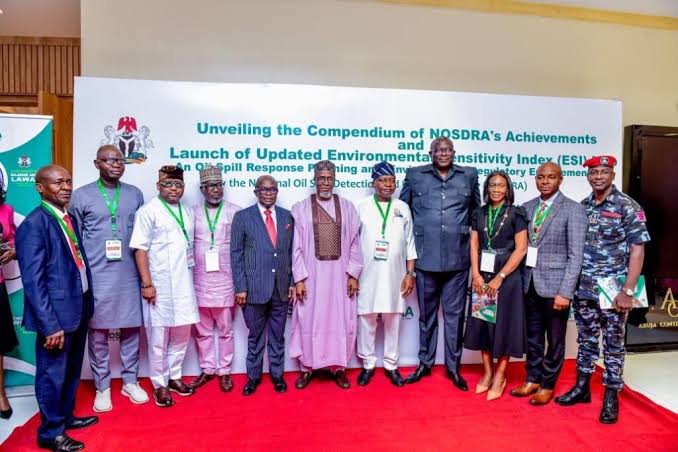
Nigeria has reaffirmed its commitment to sustainable environmental management with the relaunch of the Environmental Sensitivity Index (ESI) Map and the presentation of the National Oil Spill Detection and Response Agency (NOSDRA) Compendium of Achievements.
The event, held on October 21, 2025, in Abuja, marked a significant milestone in the nation’s environmental governance under President Bola Ahmed Tinubu’s Renewed Hope Agenda.
Minister of Environment, Balarabe Abbas Lawal, described the initiative as a testament to transparency, accountability, and evidence-based decision-making in environmental protection.
He said NOSDRA’s achievements reflect institutional growth and innovation in addressing oil spills and related environmental hazards.
Lawal commended the agency for its role in implementing the National Oil Spill Contingency Plan and deploying advanced tools such as the Oil Spill Monitor, Gas Flare Tracker, and Satellite-Based Methane Emission Tracker.
He also highlighted NOSDRA’s recognition as the top-performing federal agency in the 2024 Nigeria Transparency and Integrity Index among 500 Ministries, Departments, and Agencies.
This, he noted, demonstrates the success of ongoing reforms to enhance public sector accountability.
During the period under review, NOSDRA conducted 1,424 Joint Investigation Visits and recovered nearly 15,980 barrels of crude oil from 1,512 recorded spills.
It also monitored major cleanup projects such as those in Bodo and Ogoniland, issuing 660 Closeout Certificates.
The Minister, however, expressed concern over the growing menace of artisanal refining, which accounts for about 82 percent of recorded spills, urging stronger surveillance and community engagement.
NOSDRA’s Director-General, Engr. Chukwuemeka Woke, presented the agency’s one-year stewardship report structured around three pillars—Institutional Excellence and Governance, Digital Transformation and Capacity Building, and Operational Action for Environmental Justice.
He said NOSDRA’s strengthened systems reflect transparency and inter-agency collaboration, noting that the agency’s high ranking in the transparency index has restored public and investor confidence in environmental oversight.
Woke disclosed that NOSDRA achieved unprecedented legal victories in six court cases, saving public funds and reinforcing environmental law enforcement.
He also announced expanded international collaborations, including partnerships with the European Union on remediation frameworks for artisanal refining sites and deployment of in-situ spill response tools.
Under digital transformation, NOSDRA launched an e-learning platform to enhance staff training, introduced data visualization dashboards, and began deploying satellite-based surveillance for methane and gas flare tracking to support Nigeria’s Energy Transition Plan.
The agency also prioritized field operations, certifying 355 remediation grids in Bodo, overseeing HYPREP cleanup compliance in Ogoniland, and investigating the Ibeno mystery spill through forensic analysis of crude samples.
The relaunch of the ESI Map, Woke explained, is a critical step toward proactive environmental management.
The updated map integrates modern geospatial data and local intelligence to identify ecologically sensitive zones for timely oil spill response.
It also strengthens coordination among NOSDRA and key partners such as the Nigerian Navy, NIMASA, NUPRC, and NMDPRA under the National Oil Spill Contingency Plan.
The initiative aligns with Nigeria’s obligations under international environmental conventions, including the OPRC 1990 and the Abidjan Convention.
Woke reaffirmed NOSDRA’s determination to build a cleaner, safer, and more sustainable petroleum industry, ensuring that environmental protection remains central to national development.
The DG expressed gratitude to the Federal Ministry of Environment for its support, stressing that when institutions are strengthened, “hope becomes measurable, and progress becomes inevitable.”
He stressed the imperative for Nigeria to protect its natural heritage, promote responsible resource management, and secure a sustainable future for generations to come.
