

By Abbas Nazil
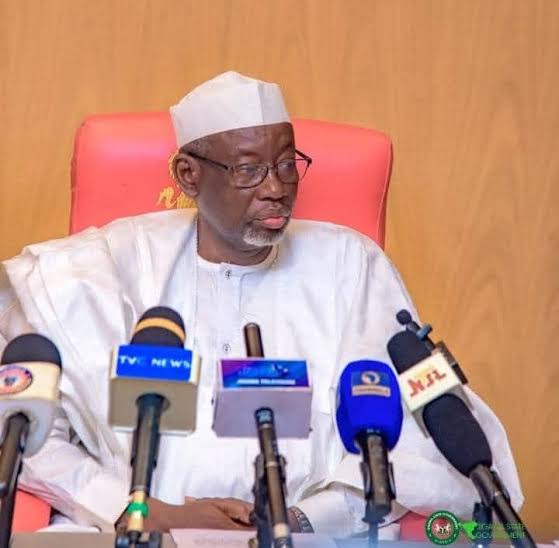
Jigawa State has marked its 34th anniversary with Governor Malam Umar A. Namadi praising the resilience of past leaders and unveiling ongoing legacy projects aimed at transforming the state into a model of progress and development.
Speaking during a state luncheon on Wednesday, August 27, 2025, the Governor recalled the journey since Jigawa’s creation under the “States Creation and Transitional Provisions Decree No. 37 of 1991,” when the state, alongside eight others, was officially established.
He said the early years were fraught with difficulties, as the state had little infrastructure and virtually no administrative structures in place, but successive administrations worked tirelessly to build a foundation.
Namadi paid tribute to the four military administrators and five civilian governors who have governed the state over three decades, noting that each contributed significantly to Jigawa’s development.
He recalled the words of the state’s first Military Administrator, General Olayinka Sule, who lamented that only one brick house existed when he assumed leadership.
From such a difficult beginning, the Governor said, Jigawa has risen to become a symbol of resilience and unity.
Among the legacies of past administrations, Namadi listed the establishment of housing estates, government offices, hospitals, and ICT infrastructure, as well as major reforms like the computerized payroll and contributory pension schemes introduced by former Governor Ibrahim Saminu Turaki.
He also highlighted Sule Lamido’s contributions, including the state airport, government guest houses, Jigawa Television, and numerous road projects, alongside the achievements of his immediate predecessor, Muhammed Badaru Abubakar, who expanded water supply, street lighting, and housing in the capital.
Governor Namadi outlined the emerging legacies of his own administration, which recently marked two years in office.
He cited the construction of over fifteen kilometers of new roads in Dutse, the dualization of Garu Road, a 600-unit housing estate of which more than 150 units are already complete, and new state-of-the-art street lighting projects.
He also pointed to the ongoing Mega Tsangaya Qur’anic School project across three senatorial zones.
Looking ahead, Namadi emphasized transformative projects such as the Greater Dutse Water Project, which has been on the drawing board for more than two decades but is now under construction with federal support.
He added that large-scale erosion and flood control works at Danmasara and Kalgo/Yalwawa would reclaim degraded lands and support irrigation.
The Governor also announced that the state had secured federal approval to convert its airport into a cargo airport, expected to boost trade and attract investment.
Expressing gratitude to traditional rulers, religious leaders, civil society, and citizens, Namadi called for unity, patriotism, and continued prayers for peace and development.
He concluded by reaffirming his administration’s commitment to the 12-point Agenda for Greater Jigawa, promising to build on the successes of the past while charting a transformative path forward.
The celebration, attended by past leaders, traditional authorities, and dignitaries, was described as both a reflection on the past and a commitment to future growth.
