

By Abdullahi Lukman
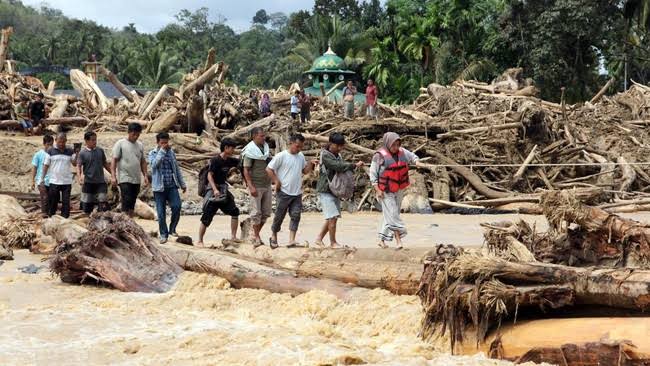
The Indonesian government has launched a wide-ranging review of environmental governance, land-use planning and corporate activities following floods and landslides in Sumatra that killed more than 1,100 people.
Although the disasters were triggered by extreme rainfall linked to Tropical Cyclone Senyar, officials and scientists say the scale of destruction was worsened by long-term deforestation and forest conversion that weakened natural flood and landslide buffers across the island.
Environment Minister, Hanif Faisol Nurofiq, said human-driven land-use changes, combined with heavy rainfall and vulnerable soil conditions, significantly reduced Sumatra’s ability to withstand extreme weather.
He described the disasters as the result of both natural and anthropogenic factors.
In a notable policy shift, the government is now explicitly linking the loss of life to development decisions, zoning practices and corporate operations, warning that permits will not shield companies from accountability.
On December 23, 2025, the government announced a three-part intervention targeting Aceh, North Sumatra and West Sumatra, the worst-hit provinces.
The first step involves a rapid assessment of disaster impacts to guide relocation, rehabilitation and permanent settlement planning, scheduled for completion by January 2026.
The aim, officials said, is to prevent reconstruction in high-risk areas.
The second measure is a comprehensive review of provincial zoning plans to determine whether they comply with Indonesia’s Strategic Environmental Assessment framework and whether they failed to prevent severe environmental damage despite formal compliance.
The third is an environmental audit of more than 100 companies operating in sectors such as mining, energy, plantations and housing.
The audits seek to establish the role of corporate activities in exacerbating the disasters and identify preventable impacts.
In North Sumatra, eight companies operating near the ecologically sensitive Batang Toru ecosystem have already been ordered to halt activities pending investigation.
The area is home to endangered species, including the Tapanuli orangutan.
According to Hanif, the audits will apply to all companies without exception, including those operating with valid licenses.
He said enforcement actions could include criminal charges, civil lawsuits or administrative sanctions, with major cases expected to conclude by March.
The Ministry of Environment is conducting the reviews in collaboration with universities and scientific institutions, with officials stressing that findings must be evidence-based and scientifically verifiable.
The government also plans to provide legal protections for academics involved in studies with potential legal consequences.
Environmental groups have cautiously welcomed the initiative, saying it could lead to long-overdue reforms if fully implemented.
Greenpeace Indonesia noted that existing zoning plans often allow development in forested areas, providing legal justification for large-scale deforestation that contributes to disaster risk.
While civil society groups remain skeptical about whether the government will revise flawed zoning frameworks, they say the new approach signals a possible turning point in how Indonesia addresses environmental accountability and disaster prevention.
