

By Rashidat Oladele
Ben, a youth farmer in Machakos County, Kenya, located east of the country’s capital, Nairobi, is currently facing a challenge with the infestation of mealybugs.
These pests have become a significant threat to the papaya production, and despite Ben’s efforts to combat them, they are proving to be resilient and retaliating against his actions.
Similar to numerous other small-scale farmers in Kenya, he confronts an ongoing struggle against papaya mealybugs. This invasive pest is rapidly expanding throughout the country, causing extensive damage to crucial horticultural crops.
The papaya mealybug was introduced to Africa from Central America in the 2000s and was initially documented in Kenya in 2016. If not properly managed, it has the potential to decimate entire harvests.
In an attempt to combat this pest, farmers are resorting to hazardous pesticides. Unfortunately, these measures frequently prove ineffective. Moreover, they harm the local biodiversity and pose risks to human health.
Nevertheless, a minuscule parasitic wasp is offering a secure and organic remedy. The consequences of the papaya mealybugFor certain farmers, such as Omar Mwandaro, a farmer residing in Kwale County, the devastation caused by the papaya mealybug nearly pushed him to abandon farming entirely.
“A couple of years back, I was an extremely disheartened farmer. I discovered that 30 papaya trees were completely ruined,” Omar remarks.
He continues by stating that their attempts to control mealybugs using pesticides were unsuccessful. Omar is not the only one facing this issue.
Melissa Awino, a small-scale farmer in Kilifi Country, was advised by an agricultural extension officer to stop using pesticides on her farm. She mentioned that these chemicals are also harmful to humans.
The excessive and excessive reliance on dangerous chemicals has resulted in negative impacts on biodiversity, including the loss of native pollinators and natural enemies of pests.
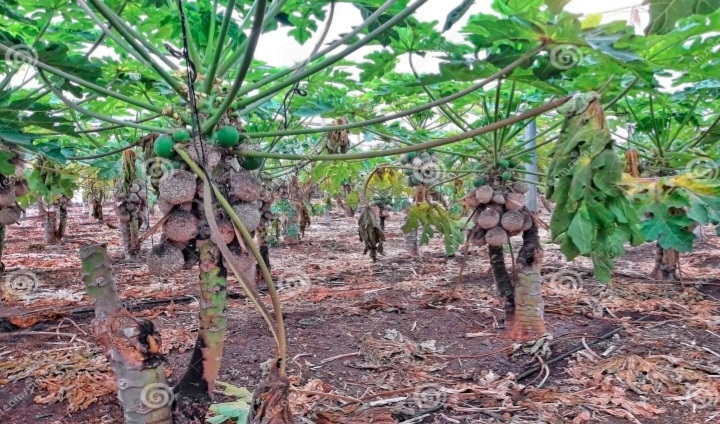
Rama Hamisi, an Agricultural Extension Officer working in Kwale County, has observed significant improvement in crops with the introduction of parasitoids.
He notes that pawpaws are now flourishing and displaying vibrant green color.
Farmers who have access to a Natural Enemy Field Reservoir (NEFR) have the advantage of on-site pest control.
This eliminates the need for CABI to repeatedly visit farms for additional releases, as the solution is already present in the area. As a result, we advise farmers to increase their cultivation of papaya..
Farmers in coastal counties in Kenya are witnessing the positive effects of using the classical biological control agent, which has been proven to be effective in controlling pests. This new method of control is not only saving them money but also time.
As a result, farmers are motivated to increase their papaya production in the future. Melissa, who now has parasitoids on her farm, expresses her determination to fill her farm with papayas.
Omar shares a similar sentiment, believing that this new method will not only secure his children’s education but also transform his life compared to his previous circumstances.
Ben notes that there is a need for farmers who can meet the increasing demand of the growing population.
He also mentions that in the future, Machakos County will adopt biological control measures. Ben believes that if he gains control, he will be able to feed more people and generate higher profits.
PlantwisePlus and its collaborators will expand the application of biological control methods across Kenya. This will enable farmers like Ben, Melissa, and Omar to decrease their reliance on harmful pesticides, while enhancing their crop yields and incomes.
This marks the initial stage of a lengthy expedition. The farming communities in nearby nations still face the persistent problem of the invasive papaya mealybug. PlantwisePlus is currently engaged in investigating the implementation of biological measures to tackle this issue in these countries.
