

By Abbas Nazil
One of the world’s largest and longest-lasting icebergs, known as A23a, is disintegrating after drifting away from Antarctica nearly four decades ago, scientists have confirmed.
The iceberg, once a trillion-tonne block of ice more than twice the size of Greater London, is now breaking into pieces as it drifts northward into warmer waters.
Oceanographer Andrew Meijers of the British Antarctic Survey explained that A23a has been exposed to milder seas for months and is “pretty much rotted through.”
Satellite images captured over the last few days show large chunks detaching from the berg, including one piece measuring 80 square kilometers, which is considered a massive iceberg on its own.
Although A23a remains about 1,700 square kilometers in size—still larger than London—scientists predict it will disintegrate completely within weeks.
As the iceberg fragments, its melting accelerates because more surface area is exposed to the warming ocean.
It is also caught in a current pulling it further north, where temperatures are even milder.
The rapid break-up means that A23a is no longer considered a threat to wildlife around South Georgia Island, where earlier concerns were raised about penguins, seals, and seabirds.
Instead, the main hazard now lies with shipping routes.
As the pieces become smaller, they will be harder to detect by satellite, increasing risks for fishing vessels and cruise ships operating in the Southern Ocean.
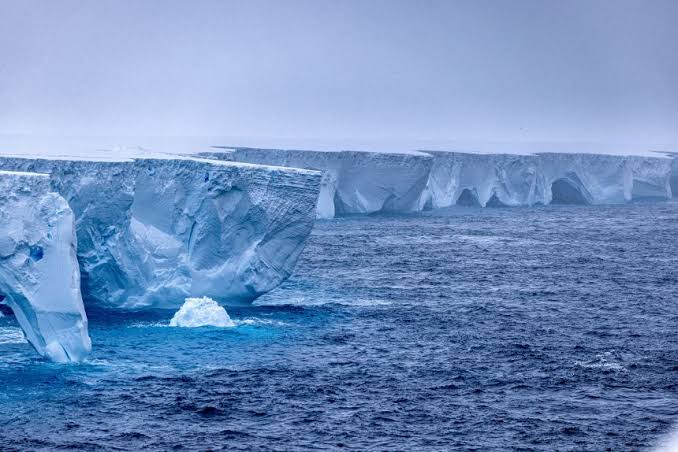
In March, when Sky News flew over A23a with the Royal Air Force as part of Operation Cold Stare, the iceberg was still intact but already showing cracks several kilometers long and massive ice caverns carved by waves.
By that point, the block was still more than twice the size of Greater London, making it difficult to imagine such a vast mass vanishing so quickly.
Despite this, its demise now seems imminent.
Scientists note that records of giant icebergs like A23a do not go back far enough to determine whether such events are increasing with climate change.
However, there is strong evidence that the West Antarctic Ice Sheet, where A23a originated, is melting faster due to global warming.
Antarctica is losing about 150 billion tonnes of water annually, with roughly half carried away in the form of icebergs.
The melting of Antarctic ice is being monitored closely because of its potential impact on major ocean currents that regulate global climate.
Researchers warn that disruptions to these currents could represent a tipping point in planetary warming.
With A23a shrinking, the title of the world’s largest iceberg has now passed to D15a, a 3,000 square kilometer mass grounded off the Antarctic coast since it broke away in 1992.
The rapid decline of A23a is a reminder of the fragility of Earth’s polar regions and the accelerating consequences of rising global temperatures.
