

By Abbas Nazil
Gazans are enduring an intensifying clean water crisis as Israel’s blockade and bombardment continue to devastate essential infrastructure across the strip.
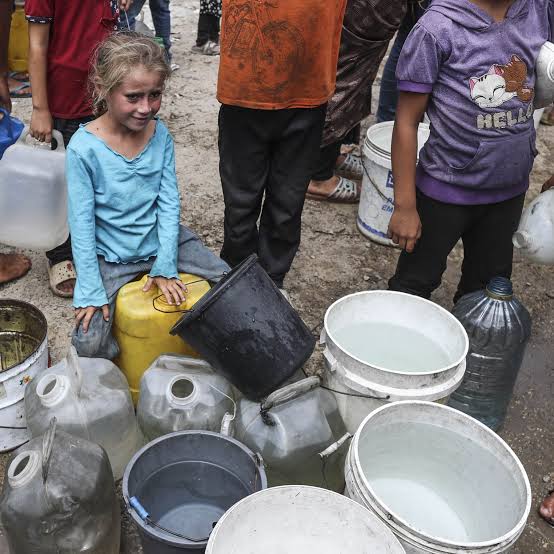
Every day, families weakened by hunger walk through the rubble-strewn landscape to fetch small quantities of water for drinking and washing.
This comes amid a deepening famine, as aid agencies warn that clean water is just as critical—and just as scarce.
With Israeli pipelines no longer supplying Gaza, and most water infrastructure destroyed, residents now rely on brackish groundwater drawn from aquifers contaminated with sewage and chemicals.
Though humanitarian organizations operate a few small desalination units, they serve only a fraction of the population.
The little water collected often spreads disease, such as diarrhea and hepatitis, due to contamination.
Israel cut off water and electricity supplies early in the war, and though it briefly resumed partial flow, damaged pipelines have since remained dry, according to Gaza water authorities.
The Israeli military’s aid coordination body, COGAT, did not comment when asked whether any water is currently being supplied.
The pumps that extract water from the aquifers need fuel for generators, but fuel is almost nonexistent in the besieged territory.
In Deir al-Balah, 23-year-old Moaz Mukhaimar said he walks a kilometer and waits two hours three times a day to bring water for his family of 20.
Dragging heavy canisters on a handcart over broken ground, he said the water is either brackish or only slightly cleaner.
His mother, Umm Moaz, worries constantly about whether they will be able to refill their containers the next day.
Their story mirrors those of nearly all families in Gaza, who now live in tents or temporary shelters without access to sewage systems or hygiene facilities.
Water shortages, along with poor sanitation, have made disease outbreaks unavoidable.
The UN says the minimum emergency level of water consumption per person is 15 liters per day.
In Gaza, Oxfam reports people are surviving on 3–5 liters.
This level of deprivation, the agency warns, is fueling the rapid spread of preventable diseases.
Oxfam’s Bushra Khalidi said that waterborne illnesses have increased by 150 percent in just three months.
While Israel blames Hamas for Gaza’s suffering and insists adequate aid is being provided, humanitarian groups disagree, citing worsening conditions and restricted access.
A new pipeline funded by the UAE is expected to supply water from Egypt to 600,000 people in southern Gaza, but it could take weeks to be operational.
Meanwhile, many Gazans, especially children, spend hours daily just queuing for water or searching for clean sources.
Fights sometimes break out at water collection points, and many residents bathe in the sea due to lack of alternatives.
Children, who once went to school, now carry plastic containers to fill for their families, having lost their childhoods to the daily struggle for water.
James Elder, UNICEF spokesperson, warned that water and food deprivation are no longer side effects of the war—they are central to its deadly impact.
Oxfam has called for an immediate ceasefire and unrestricted humanitarian access, stressing that unless conditions improve, even more people will die from easily preventable diseases.
