

By Abbas Nazil
Former Minister of Power, Works and Housing and former Lagos State Governor, Babatunde Raji Fashola SAN, has written the foreword to a new book examining Nigeria’s renewable energy legal and policy framework.
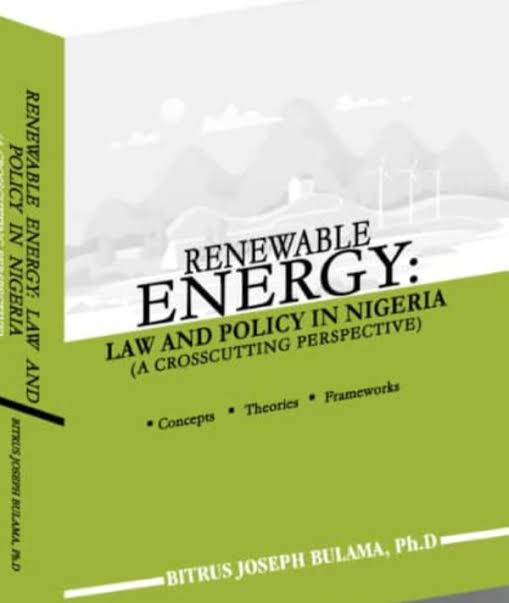
The book, titled Renewable Energy: Law and Policy in Nigeria – A Crosscutting Perspective, is authored by legal scholar Dr. Bitrus Joseph Bulama and is scheduled for public presentation on February 11, 2026.
Fashola describes the publication as a timely and seminal contribution to Nigeria’s growing renewable energy discourse, particularly at a time when the country is grappling with energy access, climate obligations and sustainable development goals.
In the foreword dated May 1, 2025, he explains that although international renewable energy advocacy dates back to the 1987 Montreal Protocol, Nigeria’s engagement with the sector only gained momentum several years later.
He traces the evolution of Nigeria’s electricity sector, highlighting the significance of the 1999 Constitution and the Electric Power Sector Reform Act of 2005, which dismantled government monopoly and introduced deregulation.
Fashola reflects on his assumption of office in November 2015 under President Muhammadu Buhari, noting that the Ministry of Power was undergoing major structural changes following the privatization of electricity generation and distribution assets in 2013.
The legal luminary said the transfer of assets and more than 5,000 staff to private operators transformed the Ministry into a lean institution with fewer than 1,000 personnel and a mandate focused mainly on policy formulation.
He explains that the Ministry’s role shifted from being a direct power provider to serving as a policy enabler within a privatized electricity market.
Fashola recalls that policies and programmes became the key tools for improving electricity supply, leading to the development of Nigeria’s first published Energy Mix Document.
That document, he recalled, committed the country to achieving 30 percent renewable energy within a projected 30-gigawatt power capacity by 2030.
He also references subsequent initiatives, including the Renewable Energy and Energy Efficiency Policy of 2015, the Mini-Grid Regulations of 2016 and the Building Energy Efficiency Code of 2017.
Fashola states that this policy background influenced his decision to accept Dr. Bulama’s request to write the foreword.
He notes that the book provides a comprehensive account of Nigeria’s renewable energy journey, beginning with a historical review dating back to 1896, when the first power station was built in Lagos with a capacity of 60 kilowatts.
He highlights Chapter Four for its detailed analysis of the legal, policy and institutional frameworks governing renewable energy in Nigeria.
Chapter Five, which he describes as the heart of the book, examines the major challenges facing renewable energy development in the country.
Drawing from his ministerial experience, Fashola says he shares many of the author’s perspectives, some of which were addressed through the Power Sector Recovery Programme implemented during his tenure.
The foreword also points to the creation of institutions such as the Rural Electrification Agency, Nigerian Bulk Electricity Trading Plc, the Transmission Company of Nigeria, the Energy Commission of Nigeria and the National Council on Climate Change as evidence of political commitment.
Fashola further cites budgetary provision for solar installations at the Presidency in 2025 as a symbolic demonstration of government leadership in renewable energy adoption.
He suggests that undocumented investments by households and businesses may mean renewable energy already contributes more than 30 percent of Nigeria’s total energy consumption.
The book, which spans over 900 pages and is published by Bar and Bench Publishers in Abuja, is positioned as a major reference for policymakers, legal practitioners, academics, investors and energy developers.
Fashola recommended the work to readers seeking a deeper understanding of renewable energy law and policy in Nigeria.
