

By Abdullahi Lukman
In a rare show of unity amid global geopolitical tensions, the European Union and China issued a joint statement on Thursday reaffirming their commitment to climate cooperation, the Paris Agreement, and green economic transition.
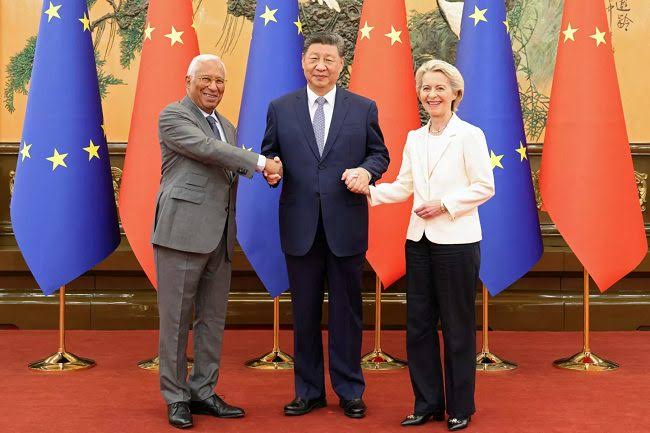
The statement followed a high-level visit to Beijing by European Commission President Ursula von der Leyen and European Council President António Costa, who met with Chinese President Xi Jinping and other top officials.
As the United States continues to retreat from international climate diplomacy, the EU–China declaration marks a strategic effort to reinforce global climate ambition and multilateral engagement.
Key commitments include submitting updated 2035 Nationally Determined Contributions (NDCs) ahead of COP30, with targets aligned to the 1.5°C goal and covering all sectors and greenhouse gases.
The statement also reaffirmed the UNFCCC and Paris Agreement as the foundation for international climate governance and emphasized the “great and special significance” of climate cooperation in sustaining multilateralism.
Despite ongoing trade tensions, both parties noted the “solid foundation and broad space” for further green collaboration.
They pledged enhanced bilateral efforts in areas such as the energy transition, clean technologies, and the green economy.
The statement came just one day after the International Court of Justice issued a landmark ruling reinforcing the legal obligations of states to protect populations from climate-related harms, adding urgency to the EU–China climate alignment.
Reacting to the development, Andreas Sieber, Associate Director at 350.org, welcomed the diplomatic gesture but stressed the need for more concrete action.
“With COP30 approaching, the EU and China must do more than commit—they must act swiftly and credibly if we are to keep 1.5°C within reach,” he said.
While symbolic, the EU–China joint statement signals a stabilizing moment for global climate diplomacy in an increasingly fragmented world order.
