
Environmental bodies unite against GMOs, say government agencies in Nigeria confused about safety

By Obiabin Onukwugha
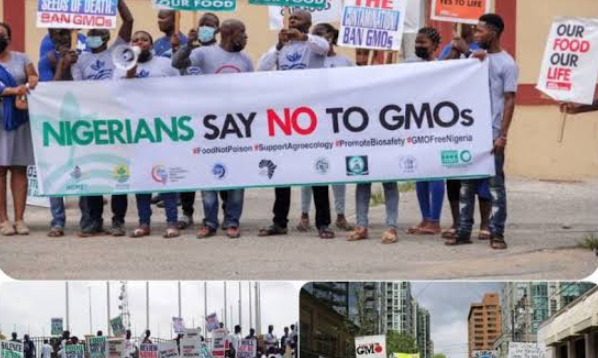
Health of Mother Earth Foundation (HOMEF), Environmental Rights Action and the GMO-Free Nigeria Alliance, a coalition of over 80 civil society organisations, researchers, farmers, women and youth groups representing the interest of millions of Nigerians has condemn the inconsistency from Nigeria’s foremost agency responsible for safeguarding the health of Nigerians on matters of food and drugs with regard to the safety of GMOs.
On Thursday, 8 August 2025, the Director-General (DG) of the National Agency for Food and Drug Administration and Control, Prof. Mojisola Adeyeye, stated that “genetically modified organisms known as GMOs, particularly in food, are not harmful to human health, provided that safety protocols are followed.”
Speaking on the safety of GMOs in an interview on Channels on Thursday, Adeyeye noted that: “GMOs are genetically modified foods and they are not bad for us. They’re not. They are not bad for us, depending on what type of foods they are and whether these safety considerations have been taken.”
However, in June 2024, the DG – Professor Mojisola Adeyeye – made statements expressing concerns about Genetically Modified Organisms (GMOs) in Nigeria. During an interview on Arise News Television. She stated that “NAFDAC does not consider GMO foods safe for consumption due to insufficient research and data at the agency’s disposal regarding their safety.” She emphasised that “until we get very convincing data to show the safety for human consumption,” NAFDAC’s position remains that GMOs are not safe. While acknowledging potential uses for non-food crops, she maintained that there’s no evidence from NAFDAC that they are safe for human consumption.
Reacting the environmental bodies queried the reversal by Adeyeye. The bodies in a statement on Sunday querried: “Why has the DG of NAFDAC changed her mind on the safety of GMOs? Where is the rigorous, independent and long-term research that NAFDAC or the National Biosafety Management Agency (NBMA) has conducted to confirm that GMOs are safe for consumption or what exactly informs this radical change of opinion?”
According to Professor Johnson Ekpere, an Independent Consultant and Convener of the GMO-Free Nigeria Alliance, “these agencies are yet to show evidence of a robust, long-term and independent study, particularly feeding studies to confirm that GMOs are safe.
The bodies revealed that a recent rat feeding study by Iranian scientists showed substantial liver and kidney damage in rats fed GM soybean oil for 90 days. They insisted that studies have also shown a connection to tumours and immune disorders manifesting as asthma, allergies and more.
“This sort of inconsistency and falsehood peddled by agencies of government who are saddled with the responsibility to protect our health and environment is unacceptable,” the stsrenent read
Executive Director of HOMEF, Dr. Nnimmo Bassey, noted that “the setbacks on GMOs go beyond health complications to long-term and possibly irreversible soil/environmental degradation. He cited the report from the National Cotton Farmers Association of Nigeria, where the farmers lamented that after 3 years of planting the pesticidal cotton (Bt cotton), conventional crops are not growing on those soils. He stated that Herbicide tolerant GMOs (which make up about 80% of GMOs worldwide) have led to the critical destruction of biodiversity as the herbicides the GMOs are designed to withstand do not only kill target pests but also beneficial organisms within the soil ecosystem.
“These herbicide-tolerant GMOs have also led to the development of super weeds, forcing farmers to require even more toxic formulations of herbicides that are not only injurious to the environment but also to human health,” Bassey insisted.
A Medical and Molecular Microbiologist, Dr. Ifeanyi Casmir, warned that “Bt Crops, for example, the Bt beans that were approved for commercial release in 2019 and 2024, respectively, contain proteins that when released into the soil destroy soil microorganisms, leading to soil degradation and reduced fertility”
Casmir also noted that studies have found Bt toxins in 93% of pregnant women and 80% of fetal cord blood, raising risks of birth defects, cancer and allergies
“The fact that our regulatory agency–the National Biosafety Management Agency (NBMA) cannot show any evidence of independent and extensive risk assessment conducted shows irresponsibility and lack of concern for public health”, he said.
The Deputy Executive Director of Environmental Rights Action, (ERA), Barr Mariann Bassey-Olsson, stressed the threat to Nigeria’s food sovereignty. She noted that “GMOs pose a critical risk of genetic contamination of our indigenous seed varieties owing to gene transfer.
“For this reason, Mexico and a host of other countries have placed a total or partial ban on GMOs. We cannot overlook such a grave threat to our plant genetic resources, especially as such contamination is irreversible.
“GMOs foster dependence on foreign seed companies, since they do not produce well after the first planting, and farmers are forced to buy new seeds season after season. Moreso, GMOs are patented–meaning their producers have exclusive rights to the seeds for many years. This prohibits the selling or exchange of seeds, which is an age-old practice by our farmers. Bassey-Olsson added.
Joyce Brown, Director of Programmes at HOMEF, queried the recent submission by the DG of NAFDAC, saying, “Beyond the MoU signed with NBMA, what is NAFDAC doing about the over 50 different brands of processed food products in our markets that are labelled to contain GMOs ? Did NAFDAC and NBMA certify these products?”
Brown recalled that in 2018, HOMEF and other CSOs wrote to NAFDAC to confirm if they were aware of the permit for GM Maize granted to WACOT Ltd in 2017. “NAFDAC responded that they didn’t know about such an approval. MoUs are ineffective if they fail to translate into actual collaboration and a rigorous review of processes that significantly impact the Nigerian populace. WACOT Ltd had tried to illegally import the maize but was apprehended by the Nigerian Customs Service.
“The NBMA publicly said the maize would be repatriated, but just a few weeks later, WACOT was granted approval to import the maize for 3 years. This goes against provisions of the NBMA Act 2015, which states that an applicant shall give notice 270 days before any GMOs are imported,” she stated..
The statement called on the Nigerian Senate to effect a ban on GMOs; to protect our indigenous seed varieties; protect human health; preserve the integrity of our soils/environment, and to support/promote agroecological approaches to food system challenges.
The coalition stressed the need for the government to address the root causes of food insecurity; to increase support for smallholder farmers through better access to credit, land and other resources, provision of infrastructure, and to address the crises that keep many farmers away from their farms.
