

By Abbas Nazil
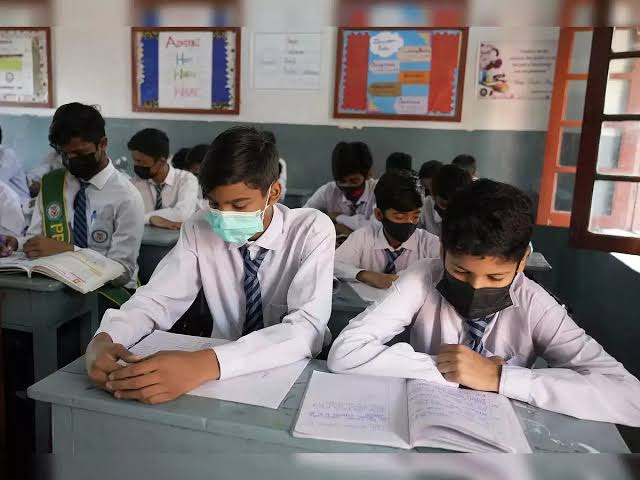
Delhi and surrounding regions are facing worsening air pollution, prompting authorities to implement stricter measures and shift schools to hybrid learning for students from Classes 1 to 9 and Class 11.
The Directorate of Education directed all government, government-aided, and recognised private schools, including those run by NDMC, MCD, and the Delhi Cantonment Board, to adopt a hybrid model combining physical and online classes wherever feasible.
Classes X and XII were excluded from this arrangement, while the choice to attend online lessons rests with students and their guardians.
Parents were instructed to be informed immediately about the new system to ensure children could continue education safely amid deteriorating air quality.
The shift comes as Delhi recorded its worst air quality of the year, with the 24-hour average Air Quality Index (AQI) reaching 431 and later surpassing 450, entering the severe-plus category, according to the Central Pollution Control Board.
All 40 air quality monitoring stations across the city reported severe pollution levels, with locations like Rohini recording an AQI of 499, Bawana 498, Vivek Vihar 495, Ashok Vihar and Wazirpur 493 each, Narela 492, and Anand Vihar 491.
Other heavily polluted areas included ITO at 485, Mundaka 486, Punjabi Bagh 478, Nehru Nagar 476, and Chandni Chowk and Okhla at 470 each, significantly impairing visibility and posing health risks.
To mitigate the crisis, the Delhi government also ordered all public and private offices to operate with no more than 50 percent staff physically present, while the remaining employees work from home.
Restrictions were extended to construction and demolition activities, limits on non-essential truck entry, and prohibitions on BS-III petrol and BS-IV diesel vehicles, while essential services such as hospitals, public transport, and utilities remained exempt.
Authorities advised children, the elderly, and people with chronic illnesses to avoid outdoor activities until air quality improves.
All stages of the Graded Response Action Plan (GRAP) remain in force across Delhi-NCR, with enforcement agencies ensuring strict implementation until further notice.
Officials did not specify a timeline for easing the restrictions, emphasizing that public health and safety are the primary priorities amid the hazardous pollution levels engulfing the city.
