

By Faridat Salifu
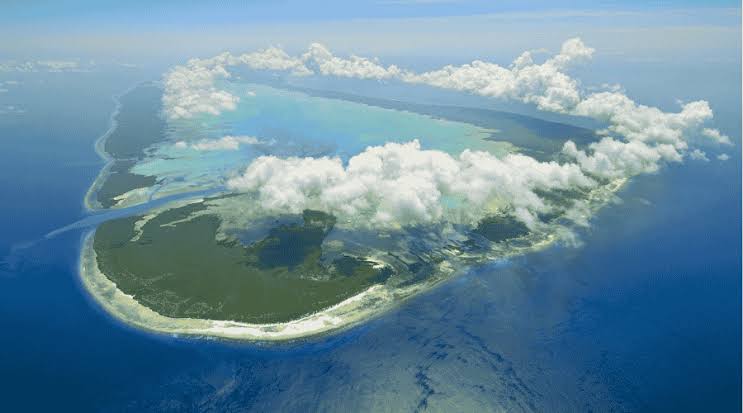
Far from Seychelles’ main islands, surrounded by turquoise waters and endless sky, lies Aldabra Atoll one of the last true wildernesses on earth and a global symbol of eco-tourism, scientific research, and environmental resilience.
Located more than 1,000 kilometers southwest of Mahé, Aldabra is one of the world’s largest raised coral atolls and a UNESCO World Heritage Site since 1982. It is an ecosystem so pristine and isolated that access is strictly controlled to protect its fragile environment.
Covering about 155 square kilometers of land surrounded by a massive lagoon, Aldabra comprises four main islands Grande Terre, Picard, Polymnie, and Malabar. Its remoteness has helped it remain largely untouched by human development for centuries.
Aldabra’s ecological richness is staggering. It is home to over 150,000 giant tortoises the world’s largest population and an array of endemic species including the Aldabra drongo, the white-throated rail, and numerous rare seabirds, reptiles, and marine life.
The atoll’s lagoon, with its network of channels and mangrove forests, shelters a diverse range of fish, rays, and turtles. Coral reefs encircle the atoll, forming a natural barrier that supports one of the most vibrant marine ecosystems in the Indian Ocean.
Managed by the Seychelles Islands Foundation (SIF), Aldabra functions not only as a conservation area but also as a vital research site where scientists study climate change, coral ecology, and species adaptation.
The SIF enforces strict eco-tourism policies. Only a limited number of visitors are allowed each year, and they must arrive via approved tours that follow environmental protocols to ensure zero disturbance to the ecosystem.
Visitors who make the long journey to Aldabra experience one of the most pristine environments on earth a living reminder of what nature can achieve when left undisturbed.
The atoll’s isolation has made it a natural laboratory for studying evolution, biodiversity, and climate resilience. Researchers often describe Aldabra as the “Galápagos of the Indian Ocean” for its ecological significance and scientific importance.
Beyond research, Aldabra represents Seychelles’ broader philosophy of balancing tourism with conservation. The revenue generated from eco-permits directly supports the foundation’s work in biodiversity preservation and public education.
For eco-travelers and scientists alike, Aldabra is more than a destination it is an experience in humility, wonder, and responsibility.
Visitors witness ecosystems untouched by mass tourism or development.
The atoll supports rare species of tortoises, birds, and marine life found nowhere else.
Ongoing studies on coral health, sea-level rise, and wildlife conservation shape global environmental policy.
Strict entry policies protect the atoll from pollution and over-visitation.
As one of the least disturbed tropical ecosystems, Aldabra remains a symbol of conservation success.
In an era of environmental decline, Aldabra Atoll stands as proof that with determination and foresight, humanity can preserve nature’s last frontiers while learning from them.
