

By Abbas Nazil
Climate change is intensifying a prolonged water crisis in the American West, with Lake Mead, the United States’ largest reservoir, falling to about a quarter of its capacity amid worsening drought, declining snowpack and extreme heat.
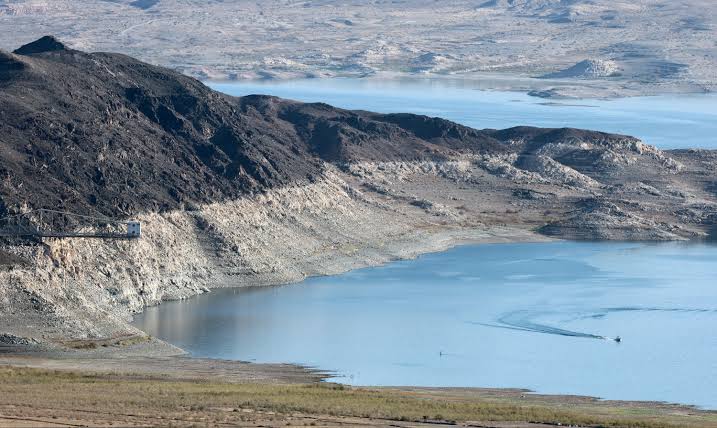
The shrinking reservoir, which supplies water to more than 40 million people across seven states, is displaying a dramatic “bathtub ring” about 186 feet (57 metres) above the current water surface, highlighting the scale of the decline.
Lake Mead and Lake Powell are critical components of a massive water infrastructure system built around the Colorado River, which supports major cities including Las Vegas, Los Angeles and Phoenix.
The Colorado River is already under severe pressure because water allocations established in 1922 exceed the amount the river can reliably provide, while human-driven climate change is worsening the imbalance.
An unusually dry winter reduced the snowpack in the Rocky Mountains, limiting the amount of meltwater flowing into the river system, while extreme heat increased evaporation from Lake Mead.
David Kreamer, a hydrology professor at the University of Nevada, Las Vegas, said climate change was making existing challenges more severe as temperatures rise and weather patterns become increasingly extreme.
Lake Powell reached an all-time low in August, while both reservoirs are approaching levels at which hydroelectric power generation could be affected.
A further decline could push the reservoirs toward “deadpool” conditions, a situation in which water would no longer flow through the dams, potentially threatening water supplies and electricity generation across large parts of the American West.
The consequences could extend well beyond the Colorado River Basin because Southern California produces a large share of the vegetables consumed across the United States, and disruptions to irrigation could affect food supplies nationwide.
The crisis has also triggered political disputes over how the remaining water should be shared among states.
The administration of US President Donald Trump recently released a 10-year plan requiring California, Arizona and Nevada to reduce their combined water withdrawals by 3.7 billion cubic metres annually, equivalent to about 1.5 million Olympic-sized swimming pools.
The upper-basin states of Colorado, Utah, Wyoming and New Mexico were excluded from the required reductions, prompting Nevada to file a lawsuit challenging the arrangement.
Meanwhile, critics point to rapid urban growth and water-intensive agriculture as additional pressures on the river.
Phoenix’s expanding real estate development and California’s large-scale production of alfalfa, a crop that requires substantial amounts of water, have been cited as major contributors to the region’s growing demand.
Las Vegas, however, has significantly reduced its water consumption over the past two decades through wastewater recycling, restrictions on lawn watering and limits on swimming pool sizes.
Despite such conservation efforts, experts warn that the combination of excessive demand and climate-driven reductions in water availability is placing the Colorado River system under unprecedented pressure.
The falling level of Lake Mead is therefore not only an environmental warning but also a growing threat to water security, agriculture, electricity generation and the future development of communities across the American West.
