

By Faridat Salifu
United Nations Educational, Scientific and Cultural Organisation (UNESCO) has launched the rehabilitation of the Aroma Agricultural School in Kassala State, Sudan.
The project, titled “SUD-INCA Invest in Capability in Sudan: Better Employability for Sudanese Youth through TVET in Kassala and Red Sea States,” is funded by the Italian Agency for Development Cooperation (AICS).
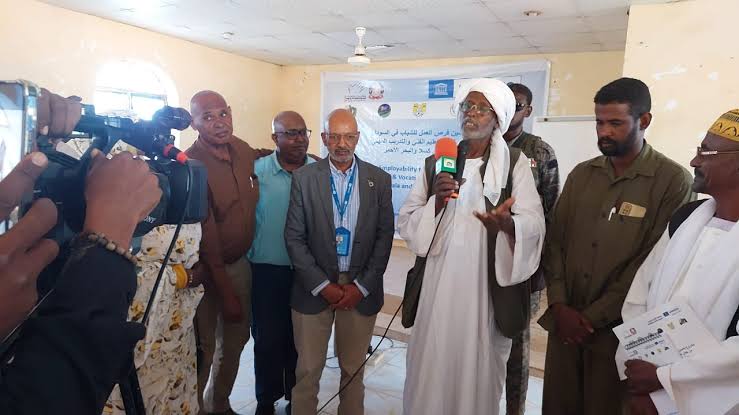
UNESCO sources say the initiative aims to revitalize technical and vocational education and training (TVET), expand opportunities for youth, support literacy, and promote local economic recovery. The launch event brought together community leaders, government officials, educators, and residents of Aroma locality.
Mr. Mohamed Al-Amin Tirik, General Chief of the Hadandawa Tribes, praised UNESCO’s engagement and said the community strongly supports the project.
He called for cultural clubs to preserve local heritage, stating, “Development must go hand in hand with preserving our identity.”
Ms. Amira Hussein Mousa, Director of the Guidance Sector at the Ministry of Education and Guidance in Kassala State, said the project is not only about training but also about restoring confidence, building skills, and opening doors for young people in the locality.
Mr. Junaid Sorosh-Wali, Head of Office and Representative of UNESCO Sudan, emphasized that Kassala is a priority for UNESCO. He noted that several of Sudan’s seven agricultural schools are currently non-operational due to conflict and other constraints.
“TVET is not a second option — it is a pathway to dignity, productivity, and sustainable livelihoods,” he said, adding that the programme will address gaps in equipment, infrastructure, and teacher capacity while supporting girls and displaced learners.
The rehabilitation will introduce updated curricula aligned with labor market needs, provide teacher training, and implement a two-year literacy programme to address foundational learning gaps.
Mr. Montasir Abdel Fattah, Executive Director of Aroma Locality, reaffirmed the commitment to eradicate illiteracy within two years, calling the project a practical step toward poverty reduction and youth empowerment.
Through the rehabilitation, UNESCO and partners aim to create an inclusive learning environment where young women and men can acquire practical skills, rebuild their futures, and contribute to sustainable development in Sudan.
