

By Abbas Nazil
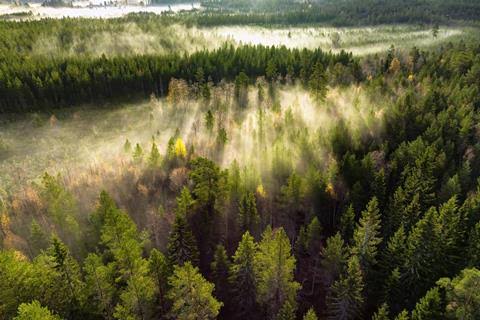
Rising atmospheric carbon dioxide is reducing the amount of nitrogen available to boreal forests, potentially slowing forest growth and weakening their role as carbon sinks.
A recent analysis of archived tree cores from Sweden shows that higher CO₂ levels make it harder for trees to compete with microorganisms in the soil for nitrogen, a crucial nutrient for photosynthesis and growth.
Boreal trees, such as Norway spruce and Scots pine, rely partly on symbiotic relationships with mycorrhizal fungi to access nitrogen from organic matter in the soil.
These fungi preferentially retain the heavier nitrogen-15 isotope while passing lighter nitrogen-14 to the trees, allowing researchers to track nitrogen availability over time.
By studying tree samples collected across Sweden from 1961 to 2018, researchers found that atmospheric carbon dioxide was the strongest factor influencing nitrogen isotope ratios in wood, outweighing impacts from nitrogen pollution caused by fertilisers or fossil fuel emissions.
As CO₂ levels rise, trees increasingly depend on fungal nitrogen, which is limited and often outcompeted by abundant soil microorganisms.
This limitation suggests that boreal forest growth may not accelerate as expected under higher CO₂ concentrations, challenging assumptions in climate models that forests will continue to act as strong carbon sinks.
Ecosystem ecologist Kelley Bassett from the Swedish University of Agricultural Sciences noted that trees can only extend their nitrogen acquisition through roots and fungal partners, while microorganisms more efficiently capture nitrogen throughout the soil.
The study implies that nitrogen limitation could become more severe in other forest ecosystems worldwide, potentially affecting overall forest health, carbon storage, and biodiversity.
Other experts, including Andrew Elmore at the University of California, Merced, highlight that declining nitrogen availability could also influence forest food webs, reducing growth in insects such as caterpillars and affecting bird populations that feed on them.
These findings underscore the need to consider nutrient limitations alongside CO₂ levels in projecting future forest growth and climate mitigation potential.
By demonstrating the complex interactions between atmospheric carbon, soil microbes, and tree nutrition, the study raises important questions about the resilience of boreal forests in a high-carbon world.
Understanding nitrogen dynamics is critical to predicting the capacity of global forests to absorb CO₂ and support biodiversity as the climate continues to change.
