

By Faridat Salifu
A new global assessment has revealed that 45 of the world’s largest meat and dairy companies emit more methane than the entire European Union (EU) and the United Kingdom (UK) combined, underscoring the livestock industry’s growing contribution to the climate crisis.
The report, Roasting the Planet, jointly published by Foodrise, Greenpeace, Friends of the Earth, and the Institute for Agriculture and Trade Policy (IATP), shows that the greenhouse gas emissions from these companies reached 1.02 billion tonnes in 2023 more than the annual emissions of Saudi Arabia, the world’s second-largest oil producer.
If grouped as a country, the report said, these companies would rank as the ninth-largest emitter globally.
Methane accounted for 51 percent of their total emissions, according to research led by Dutch think tank Profundo using UN Food and Agriculture Organization (FAO) data.
The top five polluters Brazil’s JBS, Marfrig and Minerva, alongside US-based Tyson Foods and Cargill collectively released 480 million tonnes of CO₂-equivalent gases, surpassing the emissions of fossil fuel giants BP, Shell, and Chevron.
JBS alone accounted for nearly a quarter of the total, with 241 million tonnes in 2023 more than the emissions of 158 countries combined. Greenpeace Nordic previously estimated JBS’s methane footprint to exceed that of ExxonMobil and Shell combined.
The report accused major meat and dairy companies of relying on “false solutions” such as biogas, feed additives, and carbon offsets, while continuing to expand livestock herds.
JBS, for instance, forecasts a 70 per cent rise in global animal protein demand by 2050 and has admitted its “net-zero 2040” target remains an aspiration, not a binding commitment.
According to Roasting the Planet, animal agriculture currently contributes between 12 and 19 per cent of all human-caused greenhouse gas emissions, mainly from cattle burps, manure, and deforestation linked to feed production.
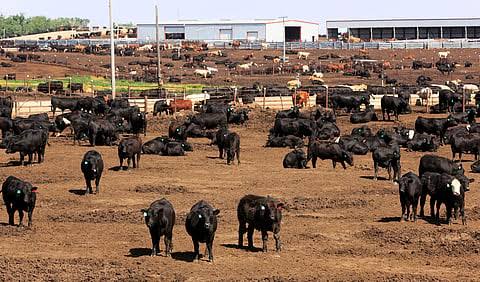
The 45 companies analysed slaughtered an estimated 17 billion chickens, 242 million pigs and 53 million cattle in 2023 about 20 per cent of global livestock.
Cattle production accounted for 80 per cent of emissions, with beef and dairy tied to 41 per cent of tropical deforestation worldwide.
Experts warn that slashing livestock methane emissions by 45 per cent before 2030 could prevent 0.3°C of global warming. However, they noted that policy responses remain heavily focused on fossil fuels, while agricultural methane receives limited attention.
Oxford climate scientist Paul Behrens, who wrote the report’s foreword, urged immediate reductions in global livestock numbers to align with the Paris Agreement.
“The sector that feeds humanity has the power to become its saviour rather than its destroyer,” he said, calling on high-income nations to lead dietary transitions.
The authors called for binding agricultural emission targets, full disclosure of Scope 1–3 emissions, and an end to public subsidies for industrial livestock farming. They also recommended a just transition towards plant-rich diets and agroecological systems as essential steps for human and planetary health.
“Every fraction of a degree matters,” the report concluded. “Governments must confront Big Meat and Dairy with urgency our shared future depends on it.”
