

By Abdullahi Lukman
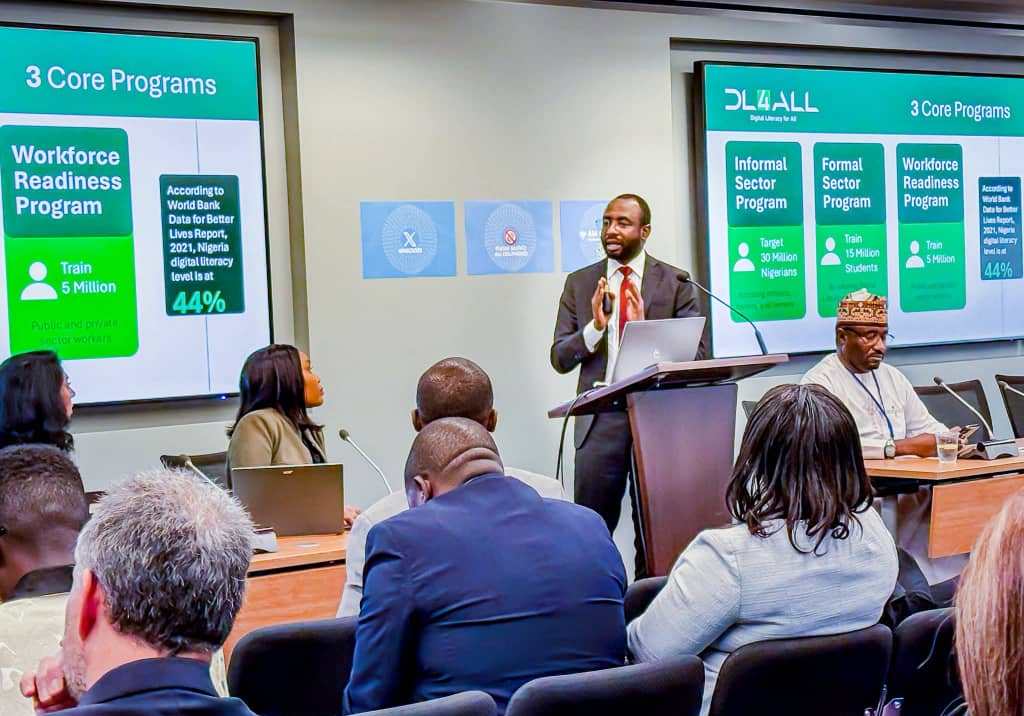
The Director-General of the National Information Technology Development Agency (NITDA), Kashifu Inuwa Abdullahi, has announced plans by the agency to create 50 million-man digitally skilled Nigerian workforce by 2027.
Speaking at the Civil Society Policy Forum during the 2025 Annual Meetings of the World Bank Group and International Monetary Fund (IMF) in Washington D.C., Inuwa also stressed the critical role of renewable energy and digital innovation in fostering inclusive growth and transforming rural communities across Nigeria.
He described renewable energy as a “fundamental enabler” for digital inclusion and economic empowerment.
“Renewable energy is not the destination. It is a catalyst — when there is power, connectivity follows, and that connectivity triggers true transformation,” he said.
Inuwa highlighted how access to clean energy, combined with technology, is revolutionizing livelihoods in rural areas, citing examples such as AI-powered farming tools, online platforms for women entrepreneurs, and remote digital jobs that allow young Nigerians to earn globally while staying in their communities.
He outlined NITDA’s collaboration with the Federal Ministry of Education to integrate digital literacy into Nigeria’s school curriculum from kindergarten through tertiary levels, and the agency’s plan to train 50 million Nigerians by 2027 to build a digitally skilled workforce.
The session also featured Fowzia Hassan, Senior Operations Officer for Infrastructure at the World Bank Group, who reaffirmed the Bank’s commitment to expanding energy access in Africa through the Mission 300 (M300) initiative, targeting 300 million new connections by 2030.
Hassan highlighted innovative financing models and partnerships designed to reach underserved communities, with a focus on empowering women and youth.
She noted that women represent 32 percent of Africa’s renewable energy workforce, mostly in non-technical roles, and called for stronger policies to enhance their participation in technical and leadership positions.
Hassan also mentioned ongoing World Bank-supported projects such as Nigeria’s DAIRS Programme, which aims to mobilize over $1 billion for mini-grids and solar systems, and the Women in Energy Network Africa (WEN-Africa), which has already created dozens of jobs for women with plans to expand further.
“Creating a clean, inclusive, and just energy transition is not just about connecting homes — it’s about empowering people, especially women and youth, to drive Africa’s prosperity,” she added.
