

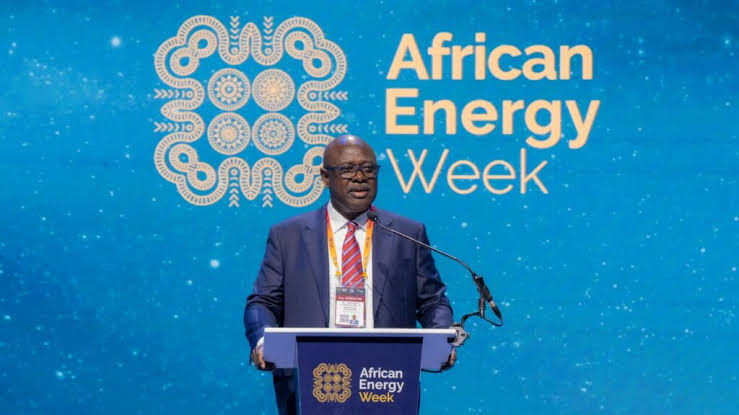
By Obiabin Onukwugha
Nigeria’s Minister of State for Petroleum Resources (Oil), Senator Heineken Lokpobiri, has stated that Nigeria is open for business and actively pursuing policies that prioritise investment, efficiency, and long-term growth in the oil sector.
The minister said with the recent divestment by oil multistionals, Nigeria is charting a bold path forward in Africa’s energy future.
The minister made this position while delivering a Keynote address on behalf of President Bola Tinubu at the Africa Energy Week, in Cape Town, South Africa.
He said recent divestments by international Oil companies have added about 200,000 barrels per day to Nigeria’s crude production, and unlocked over $5.5 billion in Final Investment Decisions within months, thereby boosting efforts to stabilise the sector.
Lokpobiri, in a statement issued by his special assistant on Media and Communication, Nneamaka Okafor, on Thursday, stressed that the Tinubu administration is committed to building a transparent, stable and investor-friendly petroleum sector to attract long-term capital.
“Of particular note were the recent asset divestments by International Oil Companies, which the Minister said have unlocked over $5.5 billion in Final Investment Decisions within months.
“These are not just transfers of assets; they are transfers of confidence, capability, and ownership. The divestments have already added approximately 200,000 barrels per day to national production.
“This gathering is more than a conference, it is a call to action. Nigeria is ready not just to participate in the global energy market, but to lead reform and growth on the African continent,” he said.
Lokpobiri emphasised that the bold policy measures implemented under the Tinubu administration, particularly the Petroleum Industry Act, provides a clear and predictable fiscal and regulatory environment for investors.
He also mentioned that the PIA has laid the foundation for licensing transparency, host community engagement, strengthened regulatory oversight, and a fair contractual framework.
“What makes Nigeria now different is the legal, regulatory, financial, and structural transformation we are delivering.
“The “Project One Million Barrels” initiative, launched by the Nigerian Upstream Petroleum Regulatory Commission in October 2024, has raised daily crude oil production to between 1.7 and 1.83 million barrels per day, with a notable increase of 300,000 barrels per day in July 2025 alone.
“Additionally, the number of active drilling rigs has grown from 31 in January to 50 by July 2025, a clear signal that reforms are unlocking value across the sector,” he said.
Lokpobiri urged the African continent to retain more value from its hydrocarbon resources by focusing on infrastructure, industrial development, and localised value chains.
He also noted that Africa spends over $120bn annually on hydrocarbons, largely through imports, calling it a missed opportunity for economic transformation.
He advocated for stronger intra-African collaboration and financing, emphasising that Africa holds nearly $4tn in domestic capital, including pension and insurance funds.
“The question is no longer about the availability of funds, but how we can channel them into productive investments on our continent,” he said.
The minister insisted that the narrative must shift toward a diverse energy mix from the abandonment of any resource, saying “The focus should be on availability, accessibility, and affordability of all forms of energy.”
He pointed out that Nigeria, like other nations, will continue to utilise its oil resources responsibly while building a diversified and sustainable energy base.
“We are offering opportunities at scale, reform with consistency, incentives with clarity, local participation with respect, and a vision that modernises with purpose.
“Come to Nigeria. Be part of the energy revolution. With strong reforms, ambitious targets, and an open-door policy, Nigeria is charting a bold path forward in Africa’s energy future,” he stated.
