

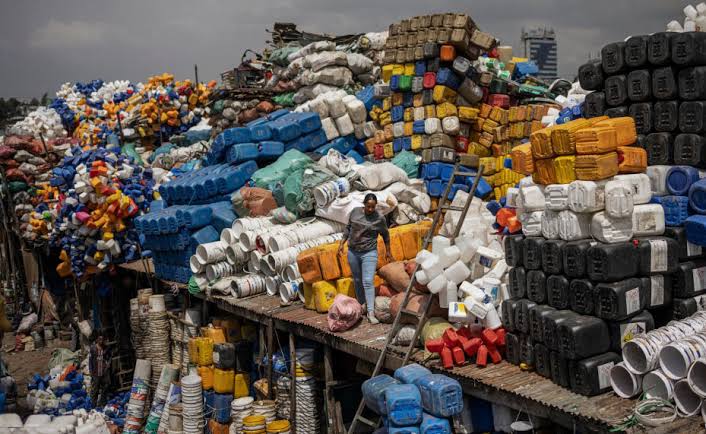
By Faridat Salifu and Abbas Nazil
Stakeholders in Nigeria’s plastic recycling sector have accused Rite Foods Limited of “greenwashing”.
This was sequel to the company’s recent disclosure that it cleared 40 tons of plastic waste from Lagos beaches through its “RiteOnTheBeach” sustainability campaign.
NatureNews notes that greenwashing refers to the practice of companies making false or misleading claims about the environmental benefits or sustainability of their products or corporate waste management practices.
Stakeholders who spoke to NatureNews argued that the cleanup, though commendable, is insignificant compared to the company’s overall plastic output and that it reflects a wider trend of misleading sustainability claims by corporates.
The beverage company, which produces brands such as Fearless energy drink and Bigi soft drinks, had celebrated the cleanup initiative as a testament of its commitment to environmental protection and sustainability.
In a statement, the company said it partnered with non-governmental organizations and coastal volunteers to rid several Lagos waterfronts of accumulated plastic waste, describing the effort as proof of its environmental responsibility.
But industry experts and waste management advocates who spoke to NatureNews raised questions on the RiteOnTheBeach plastic collection campaign, alleging exaggerated claims.
Rita Idehai, founder of Ecobarter, asked Rite Foods to disclose the percentage the 40 tons claim represents in its massive plastic production daily.
“If millions of bottles — especially the black-colored Fearless energy drink bottles — are being released into circulation daily, we need to demand more coordinated and measurable efforts from them, just as we do from global beverage giants,” Idehai said.
Another stakeholder Sunday Solanke described the 40 tons claims as “another case of greenwashing,” pointing out that Fearless bottles are among the most difficult to recycle in Nigeria.
Solanke, who is the founder of Junkyard and PETsPoint Recycling, demanded: “they should disclose who actually offtakes these recovered materials,” adding that plastic pollution on beaches is not limited to PET bottles alone.
From the informal waste-picking community, Femi Idowu-Adegoke queried the tons of recyclable and non-recyclable plastics that Rite Foods introduces into the environment each month.
Another stakeholder, Aliyu Auwal Turaki, estimated that over one million Rite Foods products are consumed daily, resulting in about 25,000 tons of plastic waste each month.
“Removing just 40 tons through a one-off program is insignificant, especially when the bottles are among the least recycled locally due to their colouration,” Turaki said.
In an interview with NatureNews, Director of Innovation and Research at Nuhu Bamalli Polytechnic, Zaria, Dr. Mubarak L. Liman tasked agencies of government that are responsible for environmental waste regulations.
He advocated stricter enforcement of Nigeria’s Extended Producer Responsibility (EPR) framework, stressing that real waste pickers and recyclers should benefit directly from corporate cleanup schemes rather than “armchair counterparts.”
NatureNews reports that the criticism of Rite Foods mirrors a broader pattern of greenwashing by plastic product manufacturers across Africa.
Environmental advocates say companies often exaggerate the recyclability of their packaging, overstate their sustainability pledges, and avoid disclosing full details of their plastic output or recovery rates.
Investigations reveal that global giants such as Coca-Cola and PepsiCo have faced similar allegations of greenwashing, while brands like Windex, H&M and Shein have also come under fire for making vague or misleading claims about their environmental impact.
Observers argue that these practices undermine public trust and delay meaningful solutions to Africa’s worsening plastic pollution crisis.
However, despite the backlash, some voices have defended Rite Foods on its unique RiteOnTheBeach initiative.
Wilson Alorti said the company’s bold initiative shows that “businesses don’t have to choose between profit and purpose”.
He praised Rite Foods for showing commitment to sustainability and environmental management through the clean up of coastal communities in Lagos, urging that the exercise should be extended to other states
Still, some stakeholders held the view that for Rite Foods and other heavy producers of plastics to gain credibility in their sustainability efforts, they must move beyond greenwashing their operations.
Let them publish transparent figures on their total plastic output, recovery volume, and long-term recycling measures, while regulators ensure accountability through strict enforcement of existing compliance frameworks, said a source.
