

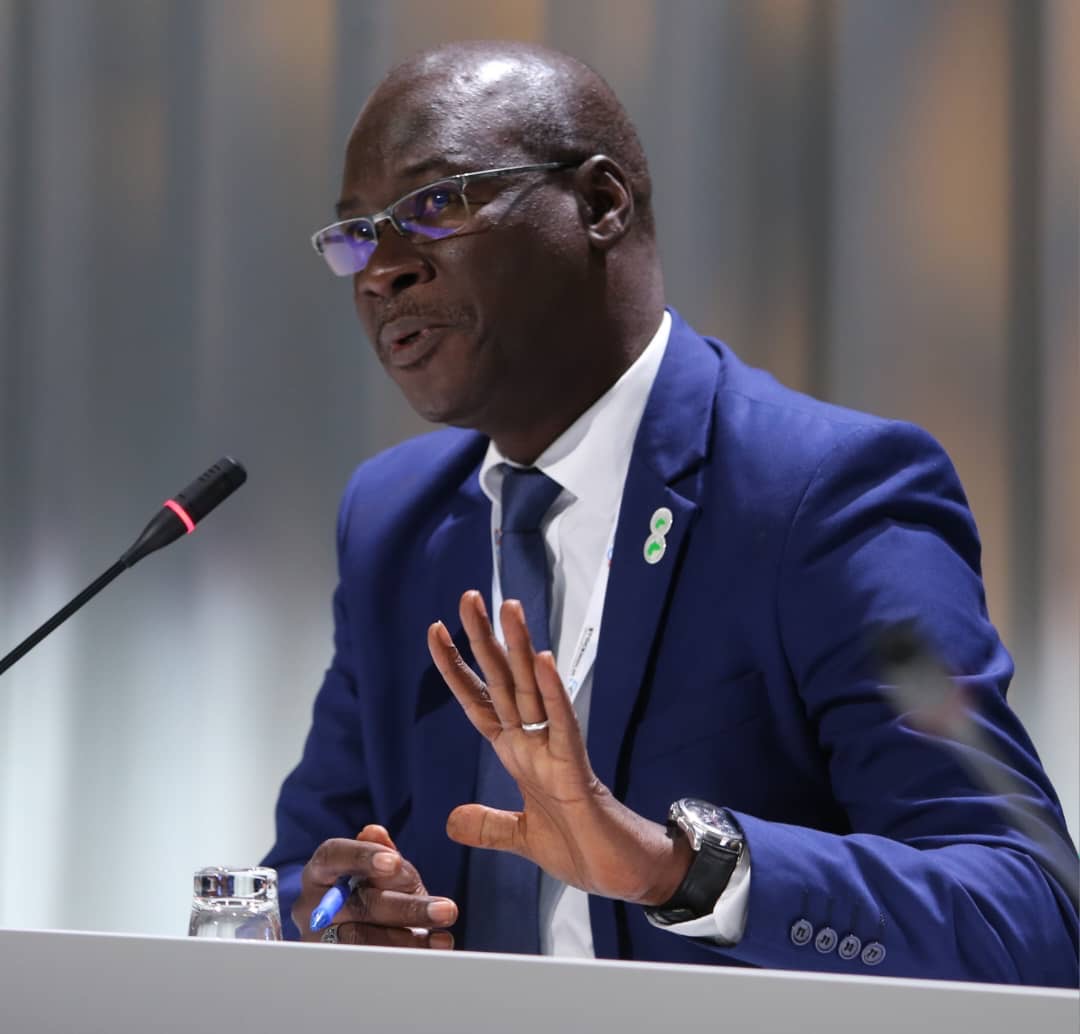
By Dr. Arona Soumaré
The title of this piece was graciously borrowed from the works of Glenn Albrecht, Australian philosopher, who gave a name to a pain that had long remained without language: solastalgia. A quiet, intimate, and collective distress felt when the familiar world transforms before our eyes—not because we leave it, but because it deteriorates. A “nostalgia” for the present, born from the feeling of still inhabiting a place that is already sadly falling apart before our eyes.
In _Earth Emotions: New Words for a New World_ (Cornell University Press, 2019), translated into French as _Les émotions de la Terre : de nouveaux mots pour un nouveau monde (Les Liens qui Libèrent_, 2021), Glenn Albrecht explores this sensitive mapping of ecological upheavals. He offers an unprecedented vocabulary to express what numbers, charts, and climate scenarios struggle to capture: the deep emotional impact of Earth’s transformations on human societies.
In 2025, Africa served as a brutal barometer of the global climate crisis. In the Senegal River Valley, exceptional floods displaced thousands of people, submerging entire villages. In East Africa, extreme rainfall linked to Indian Ocean anomalies caused deadly floods in Kenya, Somalia, and Ethiopia, affecting over 3 million people and destroying thousands of hectares of farmland. Conversely, in the central Sahel and the Horn of Africa, prolonged droughts worsened food insecurity for nearly 30 million people, while in Southern Africa, more intense tropical cyclones caused estimated economic losses of over 6 billion USD within a few weeks.
These events, far from being isolated, reflect a global trend: 2025 ranks among the three hottest years on record, with a global average temperature approaching +1.5 °C, making the African continent one of the human, economic, and ecological epicenters of climate disruption. These African climate shocks are not local anomalies—they are part of a well-documented global dynamic.
Similarly, in the year 2025, economic losses from climate-related disasters exceeded 300 billion USD, including nearly 120 billion USD in insured losses, a historically high level. More than 150 million people were directly affected by extreme events worldwide. Climate has become a macroeconomic factor, a determinant of social stability, and an accelerator of geopolitical vulnerabilities, particularly in countries with limited adaptive capacity.
On the biodiversity front, 2025 confirmed that the erosion of life is outpacing political responses. Nearly 1 million species remain threatened with extinction, while ecosystem degradation directly affects over 50% of global GDP, according to ecosystem service estimates. COP16 of the Convention on Biological Diversity, held in Rome, operationalized the Kunming-Montreal Global Framework, aiming to protect 30% of land and oceans by 2030 and mobilize 200 billion USD per year for nature. Yet fewer than 20% of countries currently have national strategies fully aligned with these goals, and the gap between ambition and financing remains vast, particularly for Africa.
The plastic pollution crisis revealed the depth of geopolitical fractures. In 2025, global plastic production exceeded 430 million tons, while less than 9% was recycled. The failure to conclude a legally binding global treaty on plastics reflects the opposition of powerful industrial and petrochemical interests to countries and civil societies demanding regulation of the full plastics life cycle.
Faced with these political limits, law has emerged as a new regulatory space. In 2025, the historic advisory opinion of the International Court of Justice affirmed that states have a legal obligation to prevent significant climate damage based on international law, human rights, and the precautionary principle. More than 2,500 climate and environmental litigations are now recorded worldwide, signaling a gradual shift of environmental governance toward the judicial arena.
This dynamic found political resonance at UNEA-7, where states recognized that environmental crises are inseparable from economic stability, human security, and peace. The Loss and Damage Response Fund (FRLD) also began to become operational in 2025, a major step for African and island nations, though mobilized amounts remain far below estimated needs, reaching several hundred billion USD per year.
The COP30 in Belém was not one of spectacular announcements but of complex, fragmented, and politically costly agreements. It produced real but difficult advances: clarification of post-2030 transition pathways, stricter oversight of national plans (NDCs), and initial steps toward aligning climate, biodiversity, and finance. These outcomes show that climate governance has entered a phase of fine political engineering, where every progress is the result of laborious arbitration between energy interests, national sovereignty, and demands for climate justice.
The world is experiencing what Glenn Albrecht foresaw. The environmental crisis is not only a crisis of nature—it is a crisis of connection, meaning, and inhabiting. In 2025, solastalgia became a shared condition, the diffuse feeling of a world we still recognize, yet already know is disappearing.
The year 2026 thus promises to be pivotal. In the face of collective solastalgia in a world already in transformation, the three COPs of the Rio Conventions (Climate, Biodiversity, and Desertification) must translate political frameworks, legal decisions, and financial pledges into concrete, tangible actions capable of restoring a real connection between humanity and its environment. In 2026, we either act to mitigate the climate crisis or succumb to solastalgia?
_Dr. Arona Soumaré is an environmental expert_
