

By Obiabin Onukwugha
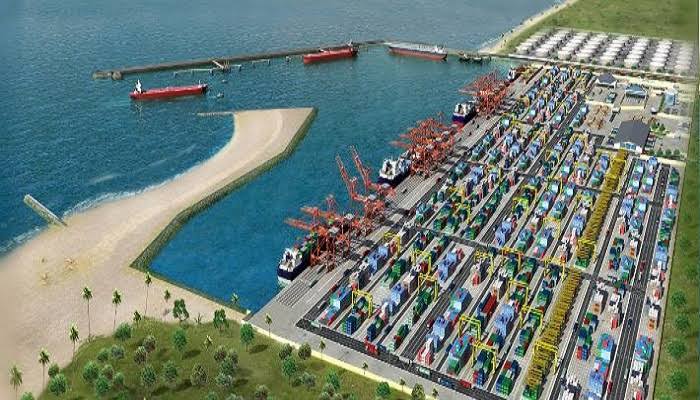
The federal government has approved $1 billion for the total reconstruction of five of its sea ports.
The ports, which include Apapa, Tincan Island, Calaber, Warri, and Port Harcourt ports, have a target delivery period 48 months.
Managing Director of the Nigerian Ports Authority (NPA), Dr. Abubakar Dantsoho, revealed this during a chat with newsmen on the sidelines of the ongoing World Ports Conference of the International Association of Ports and Harbours (IAPH) tagged, “Reinvention and Prosperity in Turbulent Times,” in Kobe, Japan on Wednesday.
Dantsoho, who is the Vice President, IAPH Africa, said the rehabilitation works are expected to commence in the first quarter of 2026, emphasising that the ports reconstruction was part of the federal government’s plan to modernise Nigeria’s seaport infrastructure in order to attract foreign investment, and reposition the maritime sector for competitiveness in the global logistics chain.
“Construction of this massive nature takes a lot of time to be able to prepare. There are engineering studies, there are environmental studies, and there is design, among others.
“It’s like building a small house, it takes you three years, for example. So, if you are building a port, it’s not what we can do easily, but we are targeting a 48-month duration for reconstruction and we’re hoping that by the first quarter of next year, we commence the construction,” he said.
He said the NPA was collaborating with other port stakeholders to attract investors to Nigeria’s ports sector. “What has happened is the absence of concrete trust and relationship for so many years. So, from what investors are saying in this conference, it is clear that what we need is collaboration.
“But how do you collaborate when there is no trust? How do you collaborate when there is no relationship? That is another area of interest to us that we must do our best to ensure that we have consolidated.
“We have to be able to be in the cycle of friends or partners that feel all of us are trusted in the same dynamics, in the same ecosystem. We also have a relationship because the port by itself is constructed to last 50 years minimum. If I’m investing in a port, I’m investing in a system that I believe will last 50 years, but that can not happen if there is no relationship,” he said.
He mentioned that Nigeria has awarded the port community system contract to a Singaporean company to drive the country’s national single window in Nigeria.
Dantosho also emphasised that with emerging technologies in shipping and port management, Nigeria must invest heavily in technology and automation across all its seaports.
“They have the equipment, they have the finance to be able to come to us because this thing is very, very capital-intensive.
“The world has moved from manual labour, that is, having a lot of people doing the same thing. Here, they are even talking about automated ships, the target is by 2040, the ships by themselves will be moving on the sea, and nobody will be on them. Nigeria do not have enough money within our own country to be able to build these massive things. But we are attracting investors now.
“We need to have collaboration, partnership with other people, because, like I said, in 2006, Nigeria moved from the public sector port system to the private sector port system. We are now going to invest a lot in technology, and this investment requires money, and people can only come and give you money if they know that they can recoup, because that’s the essence of market systems.
“We are trying to cultivate these relationships so that we are part of them. As we appear here today, we are also appearing in different conferences, and they see us as friends. We are in the Port Management Association of West and Central Africa (PMAWCA), which is the West African Association. We are in IAPH, which is the world Port, we are also in the International Maritime Organisation (IMO), so they are seeing us as friends, they are seeing us as part of the bigger family. So the discussions will continue, and then hopefully it will end in very wonderful results,” he stated.
He applauded the Minister of Marine and Blue Economy, Adegboyega Oyetola for his drive and support, adding that the federal government sees the maritime sector as a key driver of its $1 trillion economy ambition.
